See all
Save the dates of your favorite races Synchronize your calendars
See all
Stage

9

Sunday 17
May 2026

184 km
Altitude Gain 2400 m

Starting in

D ::

Cervia -

Corno alle Scale

profile

map

technical info

Route
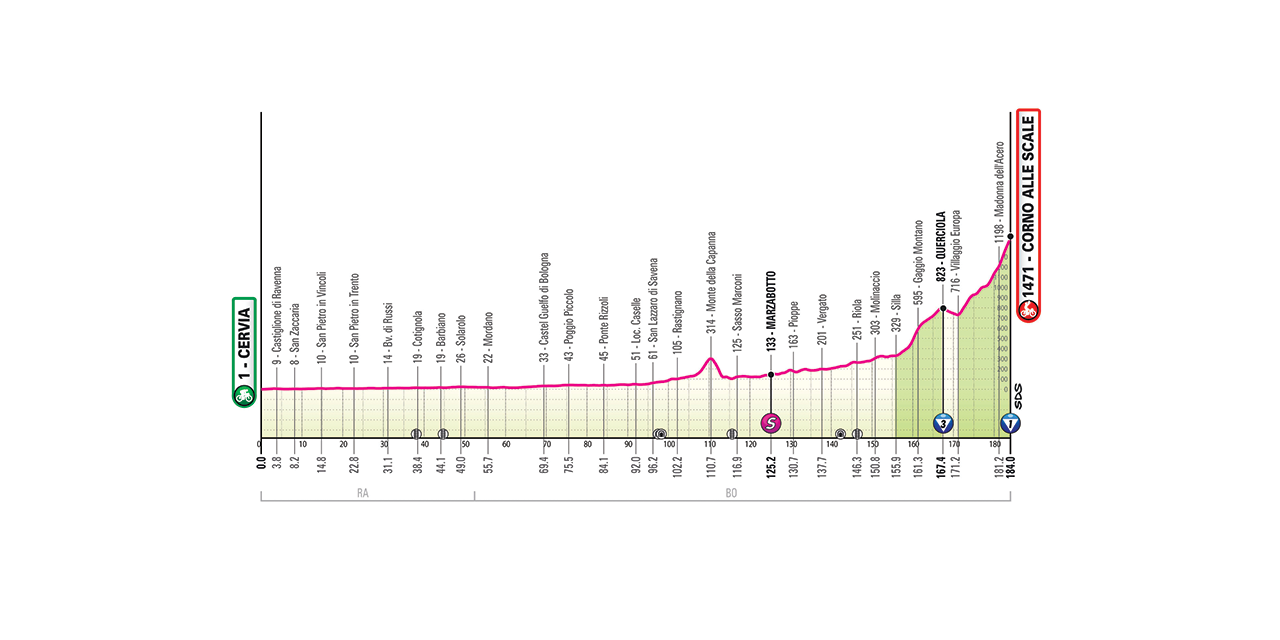
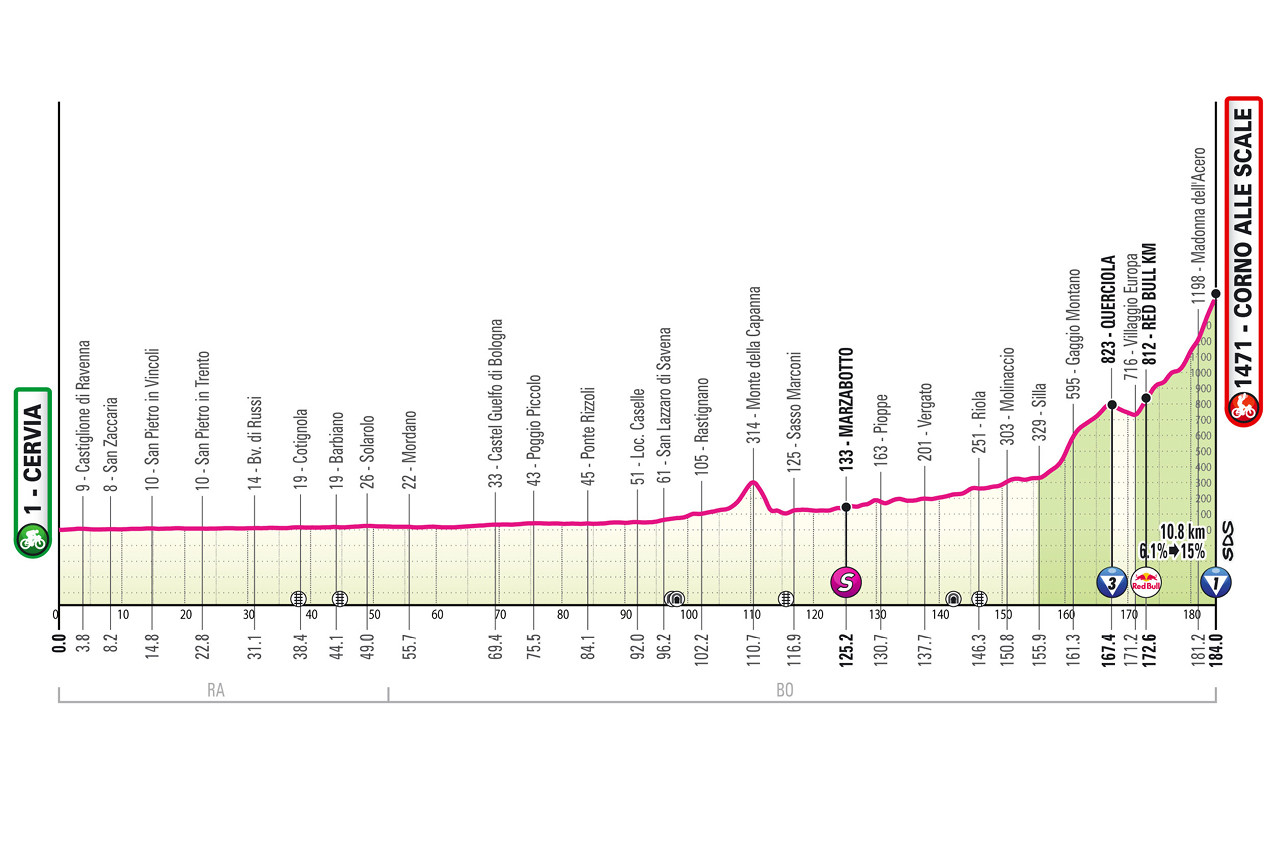
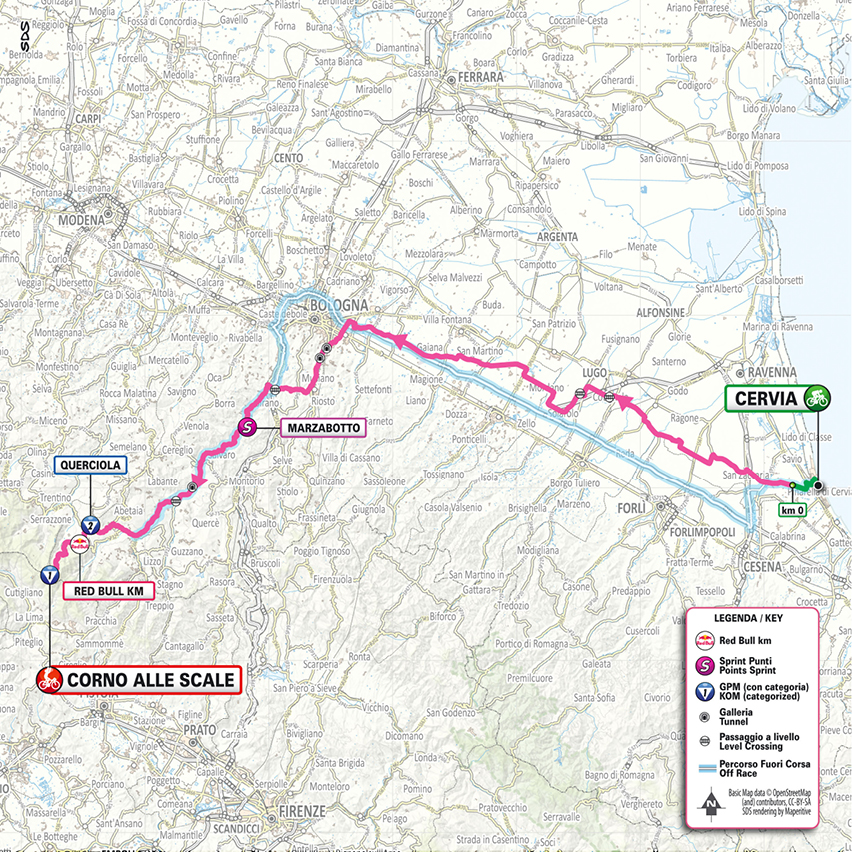
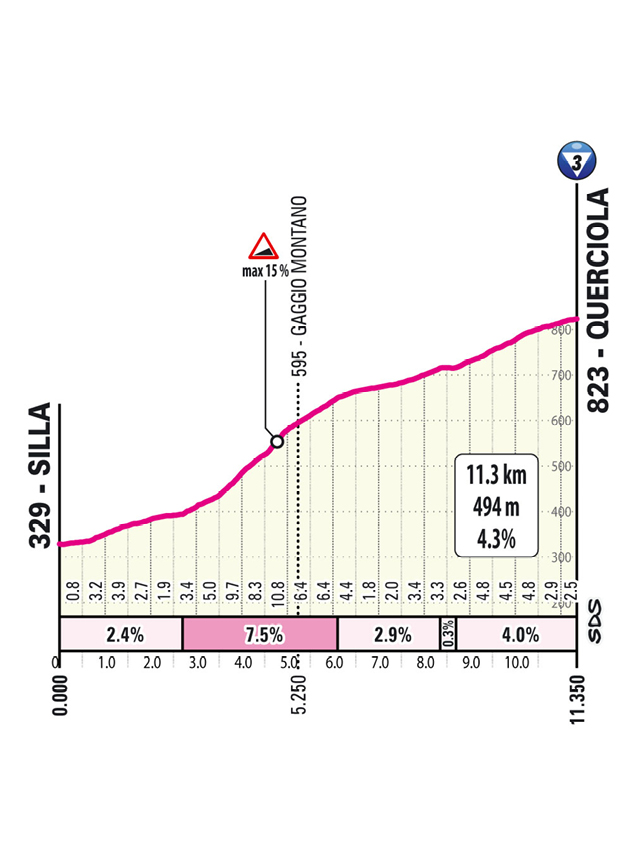
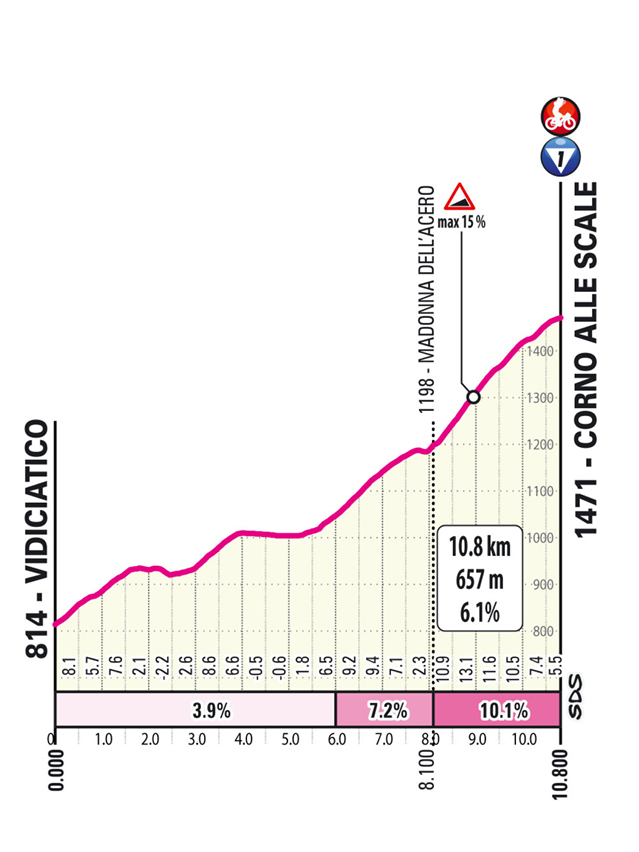
Stage that is essentially one long climb. The route is completely flat from the start to Silla, although after Sasso Marconi it begins to rise slightly along the Porrettana road. At Silla, the first KOM climb begins (effectively forming a single ascent with the final climb, separated only by a very short descent). The route passes through Gaggio Montano via the steepest approach to reach Querceta. A short descent leads to Villaggio Europa (Lizzano in Belvedere), followed by the final climb.
Final kilometres
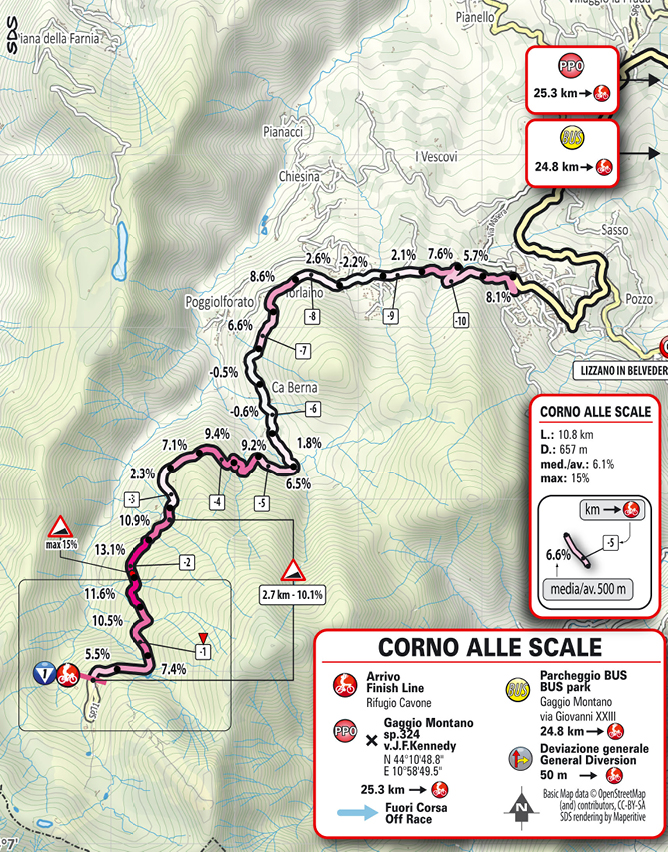
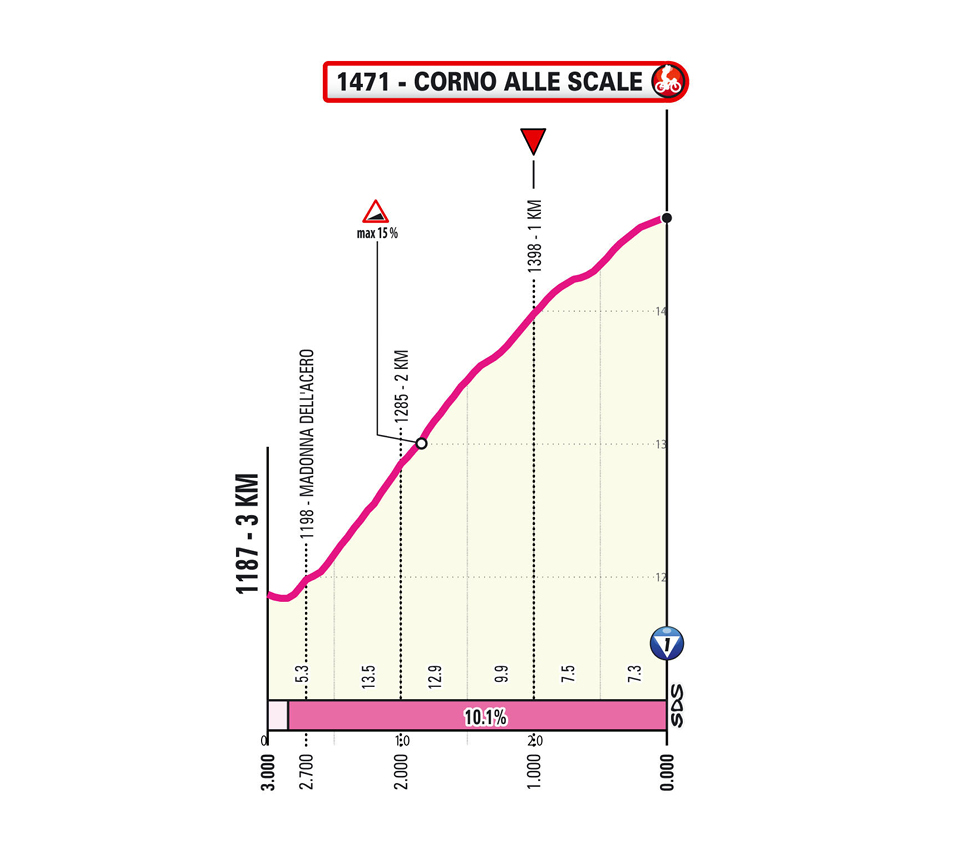
The last 12 km are all uphill on a mountain road with numerous bends and some hairpins. In the final 3 km, gradients remain above 10%, with peaks up to 15%, before easing slightly. Final straight (asphalt, 150 m long, 7 m wide) at around 7%.

start / finish

climb detail

final kilometres

itinerary timetable

Strava Route

  • profile
  • map
  • technical info
  • start / finish
  • climb detail
  • final kilometres
  • itinerary timetable
  • Strava Route
Save the dates of your favorite races and receive all the informations about the races

tourist info

Host city:

start
finish

Cervia


Overview

Located on the Emilia-Romagna coast, Cervia is a town historically linked to salt production, an activity that shaped its economic and urban development for centuries. The historic centre preserves its 17th-century layout connected to the saltworks, with the canal harbour that once linked the town to the sea and buildings originally used for the processing and storage of salt. Alongside its historical identity, Cervia established itself in the 20th century as a tourist destination, also thanks to the development of Milano Marittima. Today, the area combines a strong natural heritage, such as the Cervia Saltworks, with a well-established seaside vocation.

Gastronomy

Cervia’s culinary tradition is deeply connected to both the sea and the rural heritage of Romagna. Its signature product is the sweet salt of Cervia, harvested in the salt pans using traditional methods and prized for its delicate flavour. Among the local specialties are the Cervia mussels, cultivated just off the coast, and the Cervia cardoon, made naturally sweet through a unique cultivation technique under sand. The cuisine features iconic dishes such as piadina, handmade fresh pasta, and brodetto di pesce alla cervese, a fish stew prepared with local varieties. Also widely enjoyed are mixed fried seafood (gran fritto di paranza) and grilled meats. On the sweet side, traditional desserts include ciambella cervese and zuppa inglese, both rooted in the rich culinary heritage of Romagna.


Wine and other drinks

The Cervia area is part of Romagna’s vibrant winemaking tradition, known for its diversity and strong local identity. Among the reds, Sangiovese stands out as the most emblematic—structured, intense, and deeply expressive—alongside Cagnina di Romagna, a softer, more approachable wine. On the white side, Trebbiano di Romagna DOC is widely appreciated for its versatility, while Albana offers a range of styles, from dry to passito. Completing the picture is Pagadebit di Romagna, a light and delicate wine that reflects the authentic character of the local tradition.

Highlights & Landmarks

Cervia’s heritage is deeply intertwined with its history as a salt-producing town and its close relationship with the surrounding natural environment. The Cervia Saltworks, part of the Po Delta Park, form one of the area’s most significant ecosystems, rich in biodiversity and shaped by centuries of salt production. Within this system stands the Camillone Saltworks, the only one still operating using traditional artisanal methods. The historic centre unfolds within the Quadrilatero, a late 17th-century urban plan that preserves key landmarks such as the Cathedral and the Town Hall. The city’s productive past is reflected in the Salt Warehouses, overlooking the canal port, alongside the San Michele Tower, a defensive structure built to safeguard both the town and its valuable salt reserves. Cervia’s bond with the sea is evident in the canal port and Borgomarina, the old fishermen’s quarter, while its modern tourist identity comes to life in Milano Marittima, a 20th-century garden city set within a coastal pine forest. The surrounding landscape is enriched by expansive natural areas, including the pinewoods of Cervia and Pinarella, ideal for outdoor activities. Completing the picture are places like the Casa delle Aie, a testament to rural traditions linked to the pine forest, and the Pieve di Santo Stefano, a medieval church set in the inland countryside.

Corno alle Scale


Overview

Corno alle Scale is a mountain in the Tuscan-Emilian Apennines, located on the border between Emilia-Romagna and Tuscany, within the Metropolitan City of Bologna. At 1,945 metres above sea level, it is the highest peak in the Bologna Apennines and forms part of the Corno alle Scale Regional Park. The area is characterised by open mountain landscapes, high-altitude grasslands and forested slopes, and is well known for hiking activities as well as for its ski resort.

Gastronomy

The culinary tradition of the Corno alle Scale area is deeply rooted in the mountain culture of the Apennines, shaped by local ingredients and time-honoured practices. Among its most distinctive products is the wild black blueberry, hand-picked and used in jams, juices, and infusions following traditional recipes. Typical specialties include crescentine and tigelle, served with cured meats, cheeses, and the classic cunza. Also widespread are zampanelle (or borlenghi), thin, crispy wafers dressed with lard, garlic, rosemary, and Parmigiano Reggiano. Chestnut flour, sourced from centuries-old groves, is central to dishes such as ciacci and castagnaccio. The surrounding forests also yield prized ingredients like porcini mushrooms and the Belvedere truffle, key elements of the area’s rich and authentic cuisine.

Wine and other drinks

The beverages of the Corno alle Scale area reflect its mountain environment and strong connection to local production. The waters of Lizzano are renowned for their purity, flowing directly from the peaks of the surrounding range. Viticulture here is defined by the presence of PIWI wines, produced from resistant grape varieties and closely linked to sustainable practices, alongside wines from the Bologna hills such as Pignoletto and Barbera. Among the area’s standout specialties is the wild black blueberry, used to create juices, nectars, artisanal liqueurs, and infusions—an authentic expression of the natural richness of the Apennine landscape.

Punti di interesse

The Corno alle Scale area stands out as one of the main natural hubs of the Bolognese Apennines, where landscapes, history, and outdoor adventure come together. Among its most iconic landmarks is the Cross of Corno alle Scale, set at 1,945 metres on Punta Sofia—a breathtaking panoramic point from which, on clear days, views stretch from the Adriatic to the Tyrrhenian Sea and as far as the Alps. The Corno alle Scale ski resort forms the heart of high-altitude sports, with slopes and trails that have even hosted the training sessions of Olympic champion Alberto Tomba.
The area also bears the marks of history, particularly the Gothic Line: Monte Belvedere was a key stronghold during the Second World War and is now crossed by trails linking former positions and mountain refuges. This historical dimension is complemented by places of quiet spirituality, such as the Sanctuary of Madonna dell’Acero, set among maple and beech trees, and the Sanctuary of Madonna del Faggio, a secluded hermitage deep in the forest.

Among the mountain villages, Pianaccio – birthplace of legendary Italian journalist Enzo Biagi – features a documentation centre dedicated to his life, while Monteacuto delle Alpi preserves the charm of traditional mountain architecture. Cultural offerings include the Ethnographic Museum of Poggiolforato and the Quartz Museum in Lizzano in Belvedere.

Nature takes centre stage at the Dardagna Waterfalls, where cascading streams cut through dense beech forests, and across a network of scenic hiking routes such as the Via della Lana e della Seta and the Cammino Mater Dei. The area is also a well-established destination for cycling and outdoor activities, with routes that wind across ridgelines, forests, and valleys in the heart of the high Apennines.

Follow us
#giroditalia

top sponsor

institutional partners

official suppliers

official licensees