See all
Save the dates of your favorite races Synchronize your calendars
See all
Stage

18

Thursday 28
May 2026

168 km
Altitude Gain 2050 m

Starting in

D ::

Fai della Paganella -

Pieve di Soligo

profile

map

technical info

Route
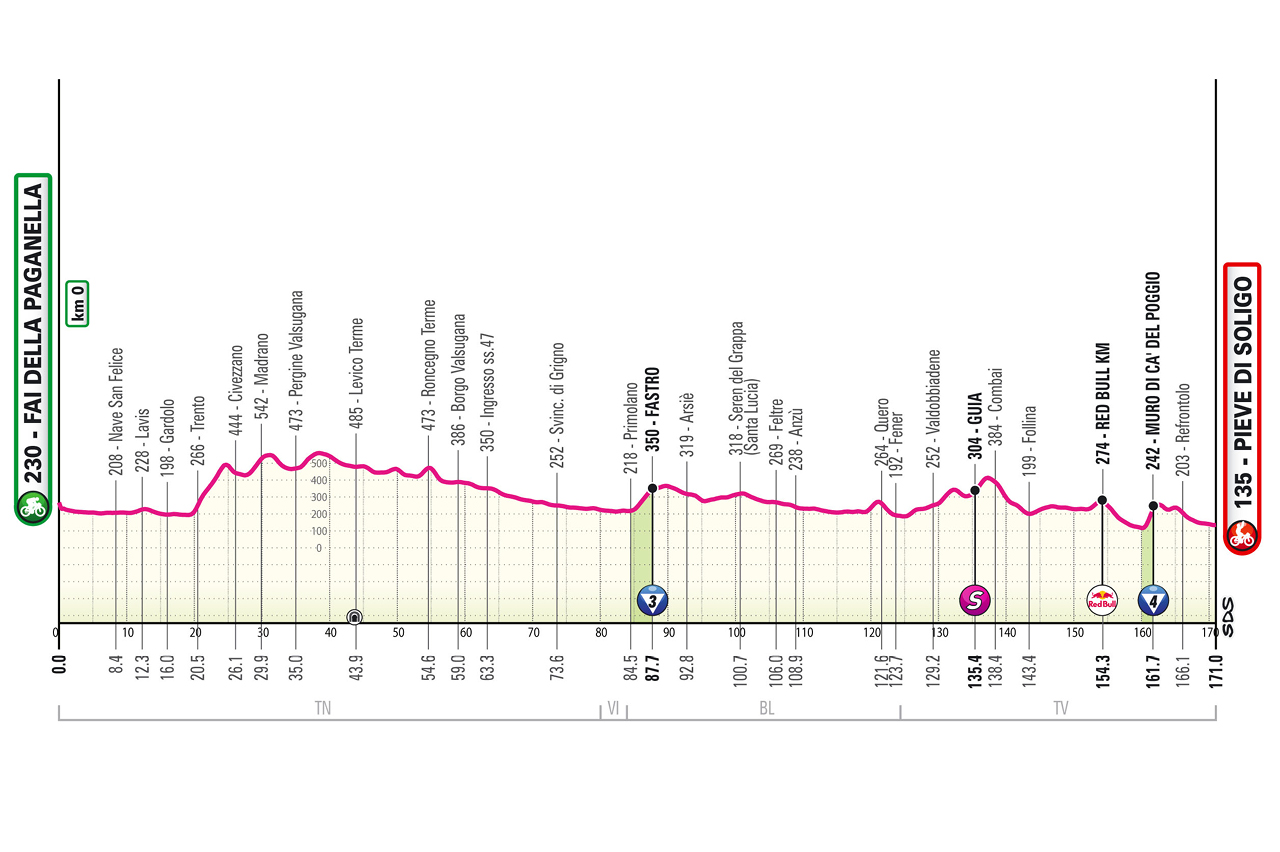
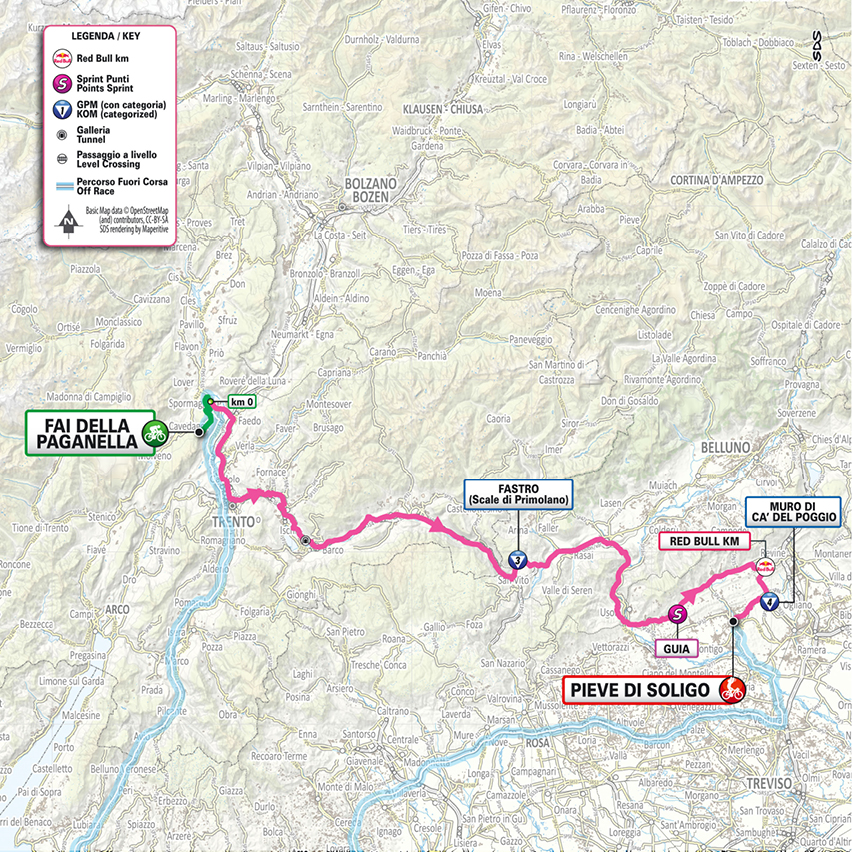
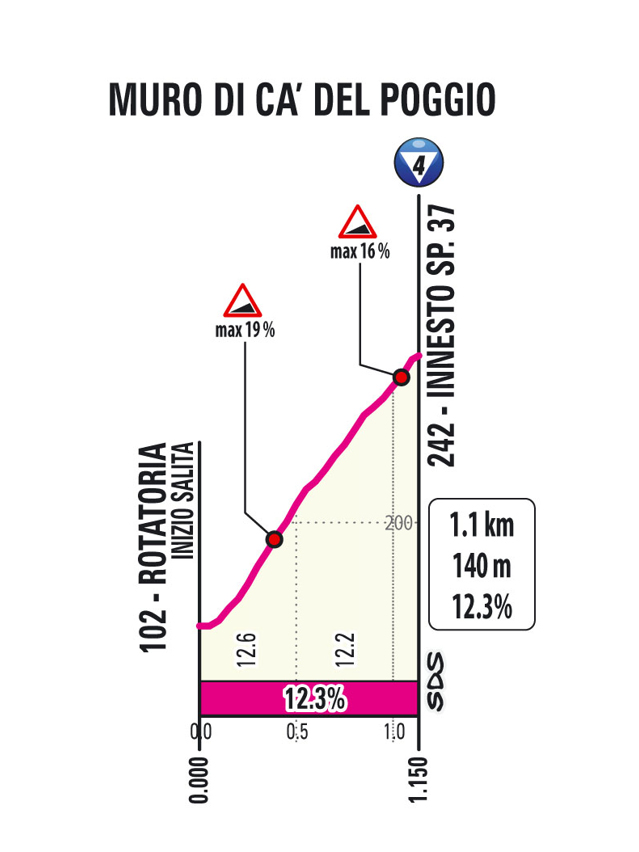
Undulating stage from start to finish. The route connects the Adige valley with the Brenta valley via the climb of Civezzano, then continues on rolling terrain that is mostly downhill towards Primolano. Riders then tackle the short climb of the Scale di Primolano to enter the Piave valley. After Valdobbiadene, the route includes a series of short climbs – Combai, Tarzo, and Ca’ del Poggio (9 km from the finish) – before reaching Pieve di Soligo.
Final kilometres
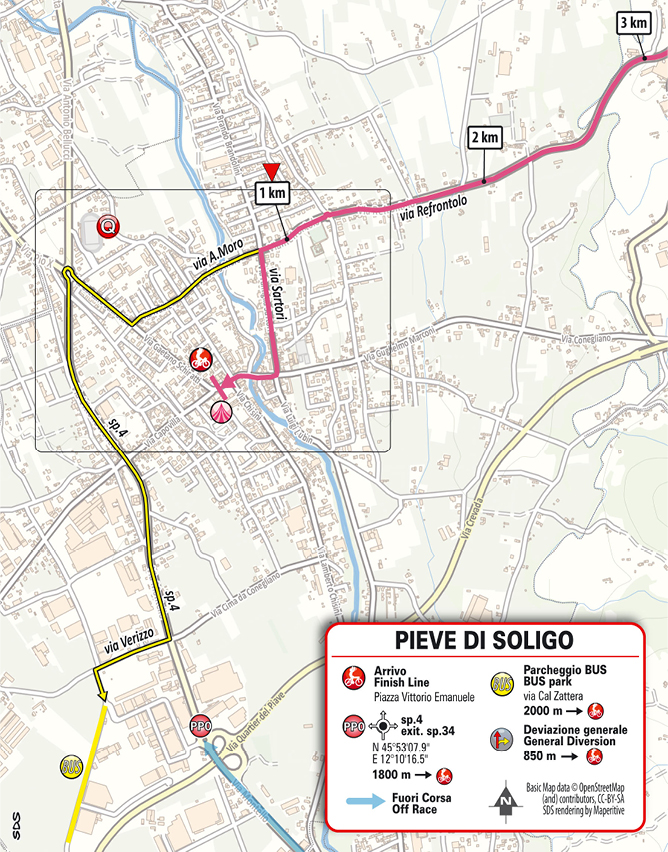
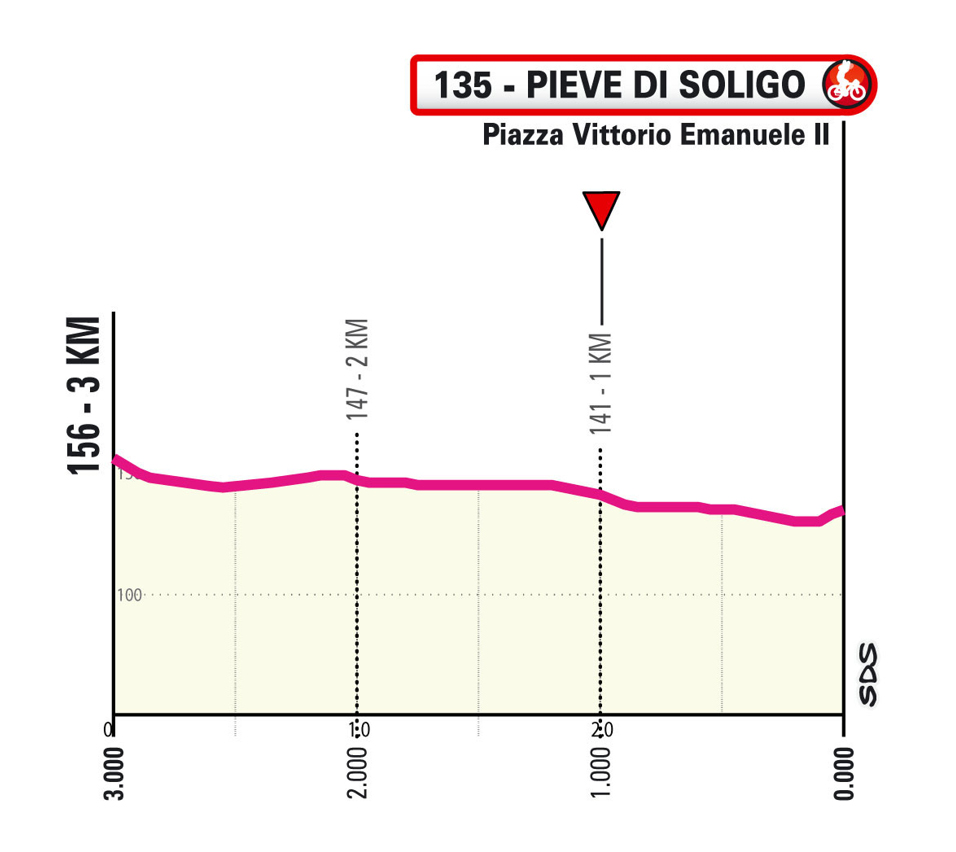
The final kilometres are mostly slightly downhill, with two bends in the last kilometre. The final bend leads into a 300 m finishing straight that rises gently, on 7 m wide asphalt.

start / finish

climb detail

final kilometres

itinerary timetable

Strava Route

  • profile
  • map
  • technical info
  • start / finish
  • climb detail
  • final kilometres
  • itinerary timetable
  • Strava Route
Save the dates of your favorite races and receive all the informations about the races

tourist info

Host city:

start
finish

Fai della Paganella


Overview

Nestled at the foot of the Julian Alps, Gemona del Friuli is one of the most historically significant towns in Friuli and has long served as a gateway between the plain and the Alpine passes. Its town centre preserves a highly valuable architectural heritage, dominated by the Cathedral of Santa Maria Assunta and a compact medieval urban layout. The city’s recent history is marked by the 1976 earthquake, which struck Gemona with devastating force and whose 50th anniversary will be commemorated in 2026. The subsequent reconstruction, carried out using innovative and community-driven approaches, has become an internationally recognised model and today represents a fundamental part of Gemona’s identity.

Gastronomy

The gastronomy of Andalo and the Paganella plateau is rooted in Trentino’s mountain tradition – simple, hearty, and deeply tied to local ingredients. At its heart is tortel di patate, made with the Kennebec potato and so iconic it even has its own brotherhood. The area is rich in agricultural heritage, especially apples, berries, and honey, thanks to thriving orchards and beekeeping traditions. Local specialties also include the prized white asparagus of Zambana and alpine char, a freshwater delicacy that reflects the region’s lakes and streams. Rounding out the food scene, craftsmanship plays a key role, from artisanal products to locally roasted coffee, where tradition and quality come together in a distinctly alpine way.

Wine and other drinks

The Paganella area is part of the wider Piana Rotaliana Königsberg, one of Trentino’s most important wine regions. This is the homeland of Teroldego Rotaliano DOC, a flagship red grown in uniquely suited soils. Alongside it thrive varieties such as Lagrein, Merlot, Cabernet, Pinot Noir, and Schiava, as well as native grapes like Nosiola. White wines are equally prominent, with Chardonnay, Sauvignon, Pinot Grigio, and Müller Thurgau offering fresh and aromatic profiles. The region also boasts a strong tradition of grappa, alongside apple juices, ciders, and locally crafted beers – each a reflection of the alpine environment and its resources.

Highlights & Landmarks

Overlooking the Adige Valley, Fai della Paganella is an alpine destination where nature, history, and sweeping views come together. One of its most fascinating sites is Doss Castel, an ancient Rhaetian settlement dating back to the Iron Age, reachable via a short hike and brought to life through informative panels.
The Fai Castle, built in the 17th century by the Spaur family, stands as a key historical landmark, while the MAS Museum (Museum of Arts and Traditions) offers insight into local customs and ways of life. For relaxation, the Parco del Respiro invites visitors into the forest for a rejuvenating “forest bathing” experience.
The surrounding landscape is a paradise for hikers, with trails like the Sentiero dei Belvedere offering panoramic views over the valley and the Brenta Dolomites. Peaks such as Monte Fausior and Cima Paganella are central to both hiking and lift-accessed exploration, making high-altitude scenery easily accessible. Themed routes like the Sentiero dell’Amore and the “De la Cornela” trail lead to scenic viewpoints such as the Pilon de la Cornela, while more adrenaline-filled experiences await on the Meriz zipline, offering a thrilling way to take in the landscape.
Cultural highlights include events like the Chimney Sweep Exhibition, which tells the story of alpine migration, and the Carta di Regola, a testament to the historic self-governance of Trentino’s rural communities.

Pieve di Soligo


Overview

Set within the hilly landscape of the Quartier del Piave, Pieve di Soligo is a town in the province of Treviso crossed by the Soligo River. Its origins are ancient and closely linked to the religious and administrative role of the parish church, from which the town takes its name. The municipal area lies within the Prosecco Hills of Conegliano and Valdobbiadene, recognised as a UNESCO World Heritage Site, a landscape shaped over the centuries by viticulture.

Gastronomy

Pieve di Soligo’s food culture is pure Veneto at its most authentic: rich in tradition and built around bold, communal flavors. The undisputed star is spiedo, a slow-roasted meat feast that defines the local identity. It’s celebrated every year with the legendary Spiedo Gigante, an event dating back to 1956 that has even made it into the Guinness World Records. Hundreds of kilos of meat – especially quail – are cooked for hours over an open spit and served with classic white polenta. Keeping this tradition alive is the Accademia dello Spiedo d’Alta Marca, dedicated to preserving recipes and safeguarding local products

Wine and other drinks

Pieve di Soligo sits at the heart of the Conegliano-Valdobbiadene Prosecco DOCG area, a UNESCO World Heritage cultural landscape since 2019. Here, vineyard-covered hills roll endlessly, shaped over centuries by the bond between people and land. The result is one of Italy’s most celebrated wines: Prosecco DOCG, loved worldwide for its fine bubbles, fresh character, and elegant balance – an authentic expression of this unique terroir.

Highlights & Landmarks

Pieve di Soligo offers a layered blend of history, culture, and landscape deeply tied to its surroundings. The city’s main religious landmark is the Duomo di Santa Maria Assunta, built between 1936 and 1937, home to notable artworks including a 1540 altarpiece attributed to Francesco da Milano and sculptures by Marta Sammartini and Giovanni Possamai. It also holds the tomb of Blessed Giuseppe Toniolo, a key figure in Christian social thought.

Among the town’s most iconic spots is the Ponte del Contenzioso, once a wooden bridge and the site of historic disputes between neighboring territories, its name still echoing its strategic past. The urban fabric reflects its former economic vitality, with buildings like Palazzo Balbi-Valier, tied to the silk industry, and the Loggia dei Granai, once a bustling marketplace.

At the heart of daily life lies Piazza Vittorio Emanuele II, anchored by Palazzo Vaccari, now the town hall. Another highlight is Villa Brandolini, an elegant 18th-century Venetian villa with gardens and annexes, today home to cultural institutions and the Prosecco DOCG Consortium.

The surrounding hills also inspired one of Italy’s greatest 20th-century poets, Andrea Zanzotto, whose work is deeply rooted in this landscape, making the area not just beautiful, but profoundly poetic.

Follow us
#giroditalia

top sponsor

institutional partners

official suppliers

official licensees