See all
See all
Save the dates of your favorite races Synchronize your calendars
Stage

21

Sunday 31
May 2026

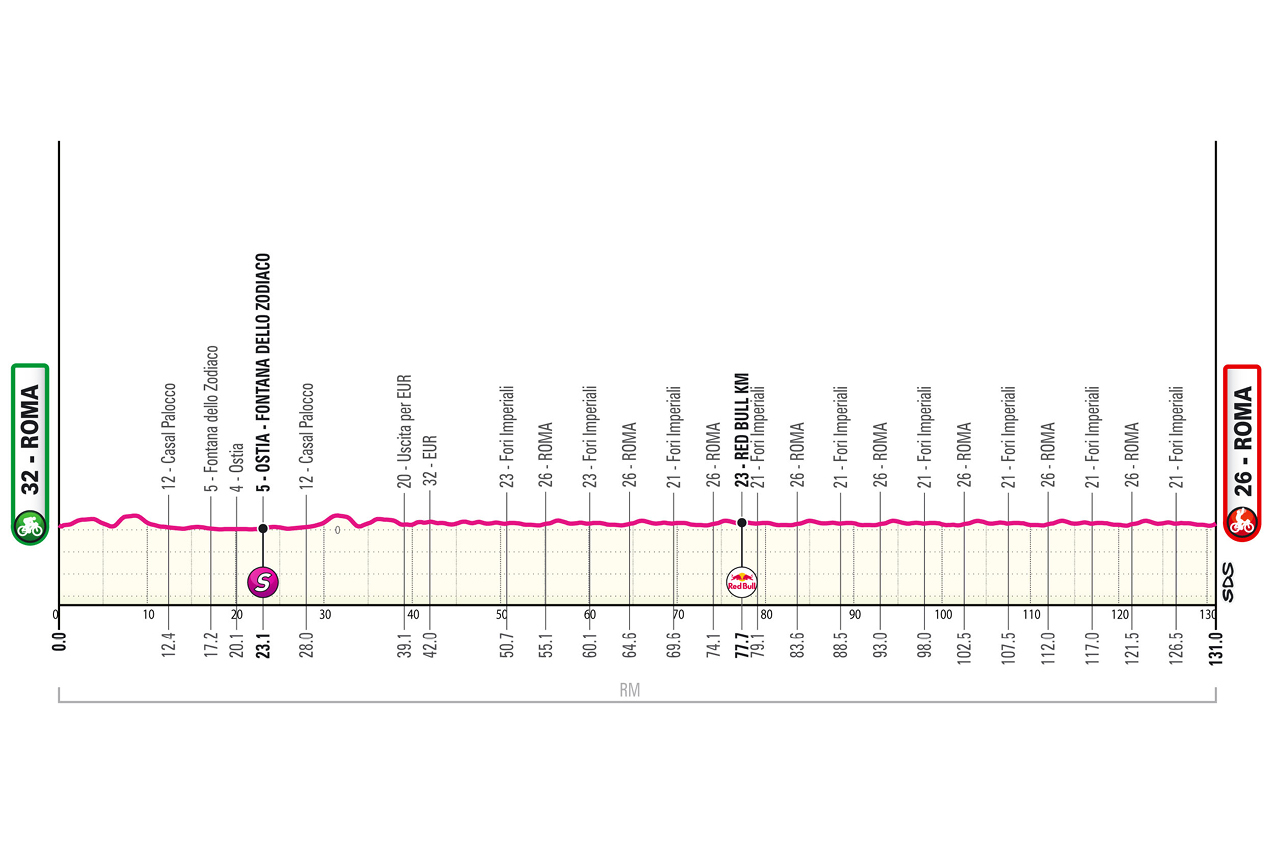
131 km
Altitude Gain 500 m

Starting in

D ::

Roma -

Roma

profile

map

technical info

Route
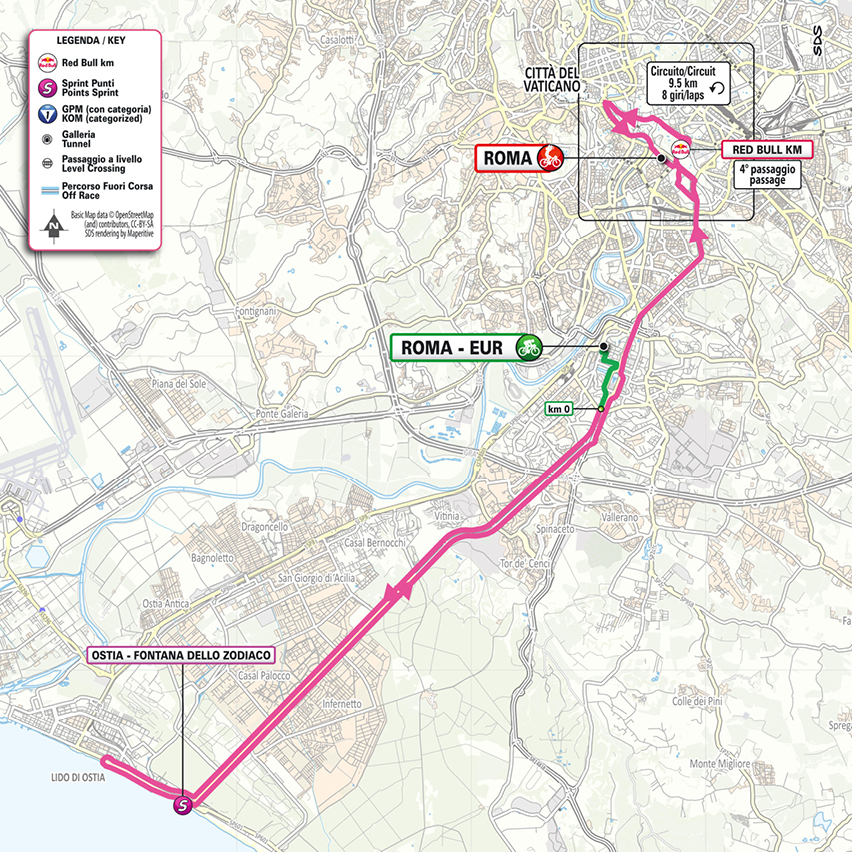
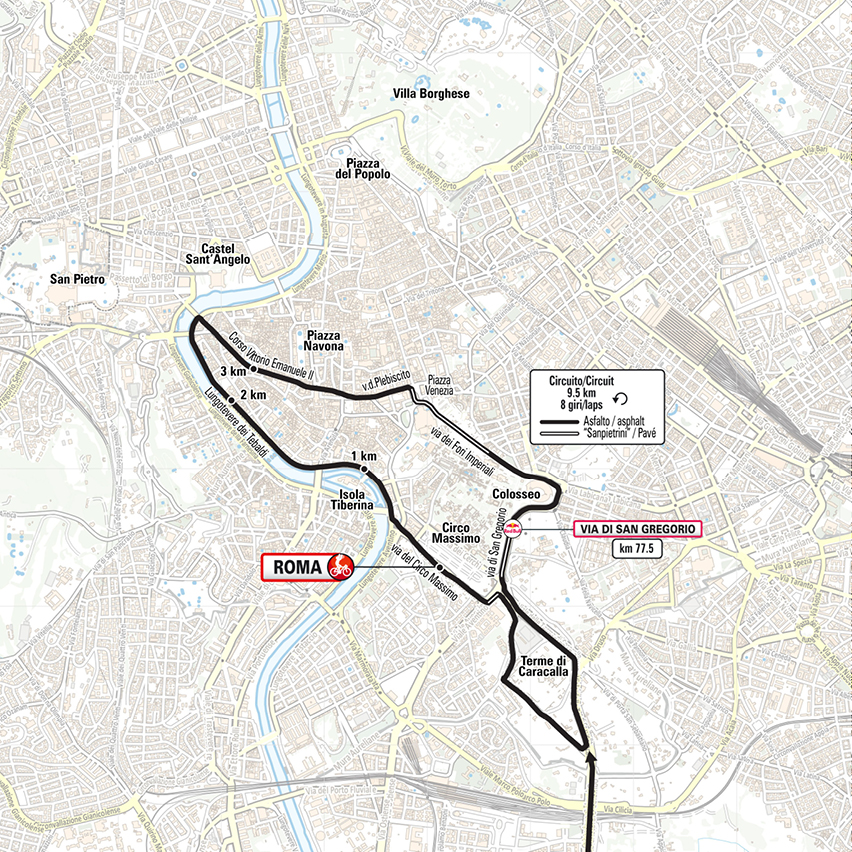
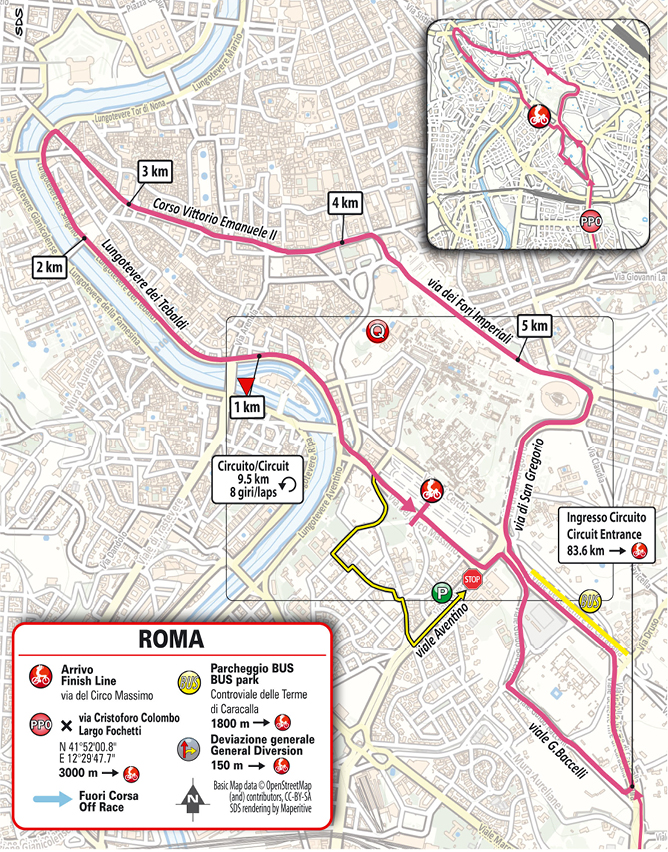
Final stage divided into two parts. The approach section starts from Rome-EUR and heads to the coast, reaching Ostia, before returning to the start area. Riders then enter the final circuit, to be covered 8 times, entirely within the capital. The 9.5 km circuit runs on city roads – wide, but occasionally featuring central reservations. It alternates short undulations with long straights connected by sometimes technical corners. The road surface is mainly asphalt, with some short cobbled sections (so-called sanpietrini).
Final kilometres
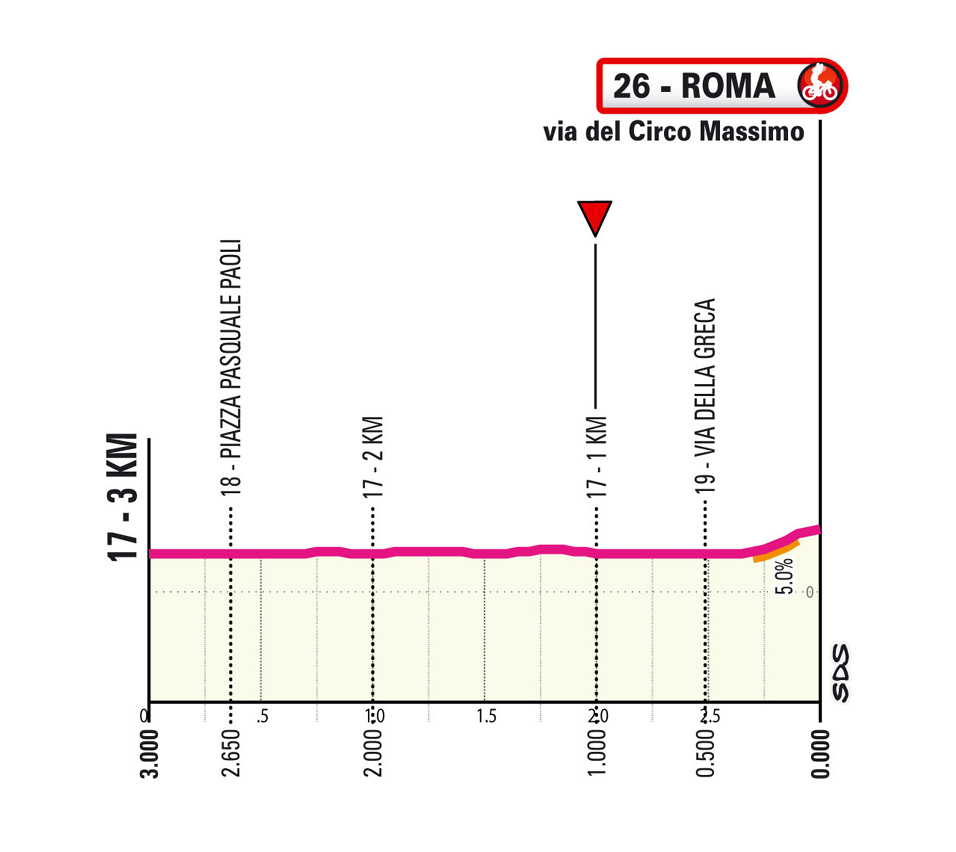
The final kilometres feature only slight changes of direction. The finishing straight is 350 m long on 8 m wide asphalt. Midway through the last kilometre, the road rises at a gradient of around 5%.

start / finish

final kilometres

itinerary timetable

Strava Route

  • profile
  • map
  • technical info
  • start / finish
  • final kilometres
  • itinerary timetable
  • Strava Route
Save the dates of your favorite races and receive all the informations about the races

tourist info

Host city:

start
finish

Roma


Overview

Capital of Italy and the heart of a history spanning more than two thousand years, Rome is a city where every era has left a visible mark. From ancient Rome, with its forums, the Colosseum and the great consular roads, to its central role in the Middle Ages and the Renaissance as the seat of the Papacy, the city has built a historical and artistic heritage without equal. Its urban fabric is a continuous interplay of ruins, palaces, churches and monumental squares, where archaeological layers coexist with contemporary life. Rome is at once the political capital, a major cultural centre and a universal symbol of Western civilisation.

Gastronomy

 Roman cuisine is one of Italy’s most iconic and authentic food traditions – bold, honest, and deeply rooted in the city’s working-class history. Built on simple ingredients and a culture of making the most of everything, it has turned humble recipes into global legends. The undisputed stars are the classic pasta dishes: carbonara (eggs, guanciale, and pecorino), amatriciana (tomato and guanciale), cacio e pepe (just cheese and pepper, yet unforgettable), and gricia, the original ancestor of amatriciana. Beyond pasta, Roman cooking celebrates the quinto quarto – offal dishes like coda alla vaccinara (oxtail stew) and trippa alla romana, telling the story of the city’s popular roots. Street food is everywhere: crispy supplì with a molten center, slices of pizza al taglio, and fragrant porchetta from the nearby Castelli Romani. Vegetables also shine, especially in dishes like carciofi alla romana and alla giudia, tied to the city’s Jewish culinary heritage. For dessert, the indulgent maritozzo filled with whipped cream leads a sweet tradition shaped by centuries of cultural influences. Roman cuisine is immediate, soulful, and unmistakably universal.

Wine and other drinks

Rome’s wine culture is closely tied to the nearby Castelli Romani hills, a historic winemaking area just southeast of the city. The most प्रसिद्ध is Frascati DOC, a fresh, easy-drinking white, alongside other local denominations like Marino DOC and Castelli Romani DOC, all rooted in a long-standing tradition of everyday convivial drinking. Light reds and more structured wines are also produced in the surrounding Lazio region. Wine in Rome is inseparable from social life – flowing freely in trattorias and traditional osterias. Another cornerstone of daily life is coffee, consumed according to precise rituals in historic cafés, while after meals, Italians often turn to herbal liqueurs and amari, completing the experience with a digestivo that reflects the country’s rich traditions.

Highlights & Landmarks

Rome is one of the most extraordinary cities in the world – a living museum where over two millennia of history unfold layer by layer. Founded, according to legend, in 753 BC, it was the heart of the Roman Empire and later a global center of Christianity, leaving behind an unparalleled cultural legacy.

Among its most iconic landmarks stands the Colosseum, the largest amphitheater of the ancient world, alongside the Roman Forum and Imperial Forums, once the political and economic core of ancient Rome. Nearby lies the Palatine Hill, one of the city’s seven hills and the legendary birthplace of Rome.

The religious heritage is equally monumental: St. Peter’s Basilica in Vatican City is one of the most important churches in the world, joined by the great papal basilicas of San Giovanni in Laterano, Santa Maria Maggiore, and San Paolo fuori le mura. The Vatican also houses the Vatican Museums and the Sistine Chapel, home to Michelangelo’s masterpieces.

Rome’s historic center, a UNESCO World Heritage Site, is filled with breathtaking squares and fountains – Piazza Navona with Bernini’s Fountain of the Four Rivers, the Trevi Fountain, and Piazza di Spagna with its famous Spanish Steps.

The city is also rich in palaces and residences, including the Quirinale Palace, seat of the Italian President, and countless noble buildings from the Renaissance and Baroque periods. The Pantheon, with its perfect dome and oculus, remains one of the best-preserved monuments of ancient Rome.

Beyond these icons, Rome offers endless discoveries: the Baths of Caracalla, the underground catacombs, vibrant neighborhoods like Trastevere with its maze of lively streets, and the Tiber River weaving through it all – linked by historic bridges such as Castel Sant’Angelo.

Roma


Overview

Capital of Italy and the heart of a history spanning more than two thousand years, Rome is a city where every era has left a visible mark. From ancient Rome, with its forums, the Colosseum and the great consular roads, to its central role in the Middle Ages and the Renaissance as the seat of the Papacy, the city has built a historical and artistic heritage without equal. Its urban fabric is a continuous interplay of ruins, palaces, churches and monumental squares, where archaeological layers coexist with contemporary life. Rome is at once the political capital, a major cultural centre and a universal symbol of Western civilisation.

Gastronomy

 Roman cuisine is one of Italy’s most iconic and authentic food traditions – bold, honest, and deeply rooted in the city’s working-class history. Built on simple ingredients and a culture of making the most of everything, it has turned humble recipes into global legends. The undisputed stars are the classic pasta dishes: carbonara (eggs, guanciale, and pecorino), amatriciana (tomato and guanciale), cacio e pepe (just cheese and pepper, yet unforgettable), and gricia, the original ancestor of amatriciana. Beyond pasta, Roman cooking celebrates the quinto quarto – offal dishes like coda alla vaccinara (oxtail stew) and trippa alla romana, telling the story of the city’s popular roots. Street food is everywhere: crispy supplì with a molten center, slices of pizza al taglio, and fragrant porchetta from the nearby Castelli Romani. Vegetables also shine, especially in dishes like carciofi alla romana and alla giudia, tied to the city’s Jewish culinary heritage. For dessert, the indulgent maritozzo filled with whipped cream leads a sweet tradition shaped by centuries of cultural influences. Roman cuisine is immediate, soulful, and unmistakably universal.

Wine and other drinks

Rome’s wine culture is closely tied to the nearby Castelli Romani hills, a historic winemaking area just southeast of the city. The most प्रसिद्ध is Frascati DOC, a fresh, easy-drinking white, alongside other local denominations like Marino DOC and Castelli Romani DOC, all rooted in a long-standing tradition of everyday convivial drinking. Light reds and more structured wines are also produced in the surrounding Lazio region. Wine in Rome is inseparable from social life – flowing freely in trattorias and traditional osterias. Another cornerstone of daily life is coffee, consumed according to precise rituals in historic cafés, while after meals, Italians often turn to herbal liqueurs and amari, completing the experience with a digestivo that reflects the country’s rich traditions.

Highlights & Landmarks

Rome is one of the most extraordinary cities in the world – a living museum where over two millennia of history unfold layer by layer. Founded, according to legend, in 753 BC, it was the heart of the Roman Empire and later a global center of Christianity, leaving behind an unparalleled cultural legacy.

Among its most iconic landmarks stands the Colosseum, the largest amphitheater of the ancient world, alongside the Roman Forum and Imperial Forums, once the political and economic core of ancient Rome. Nearby lies the Palatine Hill, one of the city’s seven hills and the legendary birthplace of Rome.

The religious heritage is equally monumental: St. Peter’s Basilica in Vatican City is one of the most important churches in the world, joined by the great papal basilicas of San Giovanni in Laterano, Santa Maria Maggiore, and San Paolo fuori le mura. The Vatican also houses the Vatican Museums and the Sistine Chapel, home to Michelangelo’s masterpieces.

Rome’s historic center, a UNESCO World Heritage Site, is filled with breathtaking squares and fountains – Piazza Navona with Bernini’s Fountain of the Four Rivers, the Trevi Fountain, and Piazza di Spagna with its famous Spanish Steps.

The city is also rich in palaces and residences, including the Quirinale Palace, seat of the Italian President, and countless noble buildings from the Renaissance and Baroque periods. The Pantheon, with its perfect dome and oculus, remains one of the best-preserved monuments of ancient Rome.

Beyond these icons, Rome offers endless discoveries: the Baths of Caracalla, the underground catacombs, vibrant neighborhoods like Trastevere with its maze of lively streets, and the Tiber River weaving through it all – linked by historic bridges such as Castel Sant’Angelo.

Follow us
#giroditalia

top sponsor

institutional partners

official suppliers

official licensees