Food
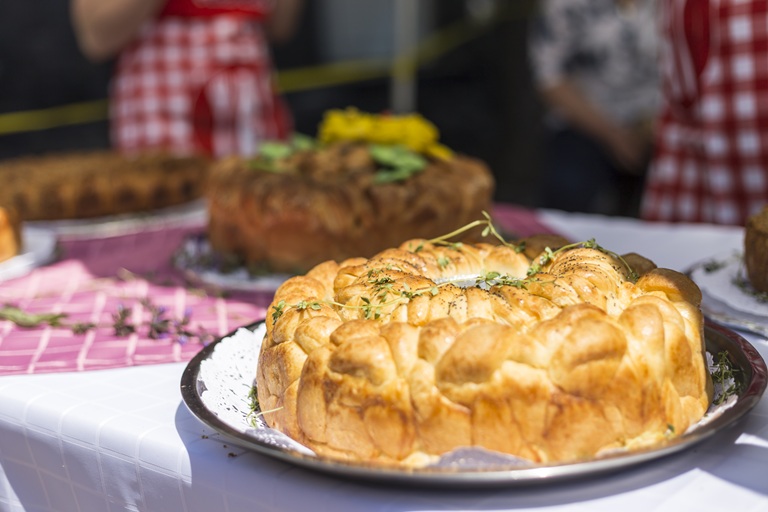
1) Banitsa – a traditional pastry with hand-pulled dough, filled with cheese and eggs.
2) Shopska salad – A fresh salad with tomatoes, cucumbers, peppers, onions, and grated white cheese.
3) Tikvenik – A sweet pastry with pumpkin, cinnamon, and sugar, typical of the region.
4) Kebapcheta and kyufte – Popular meat specialties seasoned with traditional Bulgarian spices.
5) Bean soup or stew – A classic dish prepared with local spices and served with homemade bread.
Wines and other drinks
Mavrud is one of the oldest and most emblematic Bulgarian red varietiesThe Mavrud variety has many expressions – the region produces white, rosé, and red fruity wines, as well as reds with aging potential and dessert wines.
Rubin wines are distinguished by their deep dark ruby color and aromas of juicy red forest fruits.
Red Misket is an old Bulgarian variety with pale pink skin, yet it is suitable for producing high-quality white wines.
Dimyat is a late-ripening, highly fertile and high-yielding variety, but for quality wine production, yields are limited. It is characterized by large, juicy berries with a greenish-yellow color and delicate skin.
Wines from Pamid are pale in color, light, and low in acidity, with delicate fruity aromas, making them suitable for early consumption. Rosé wines are elegant, with dominant blueberry aromas, while red wines lack potential for long aging but offer intriguing notes of red fruits and fine floral nuances.
Points of Interest
1) Architectural and Historical Reserve – Ancient Plovdiv: The historic Three Hills in Plovdiv were declared a protected area with the status of a reserve in 1956 and were named Ancient Plovdiv. Numerous monuments are preserved on the Three Hills, which allow the trace of the entire past of the city – from Prehistoric times to Antiquity and the Middle Ages. The most remarkable architectural and archeological monuments have been restored and are available for visiting.
2) The Archaeological Complex Nebet Tepe: The earliest traces of settlement at this site are from the middle of the Neolithic Age – 6th millennium BC. Later on, the ancient Thracian city of Evmolpia appeared here. Strong fortress walls surrounding a sanctuary and an aristocratic palace were discovered at this site.
3) The Ancient Theatre: The Ancient Theatre of Philippopolis is one of the best-preserved ancient theatres in the world. A recently discovered inscription on a statue pedestal indicates that the theatre was built in the 90s of the 1st century A.D. Today, the Ancient Theatre is one of the symbols of Plovdiv and has been fully adapted to the city’s modern cultural life. It functions as a stage for opera, drama, and music.
4) The Forum Complex: At the end of the 1st century, Philippopolis got a central square – a Roman-style forum – the largest forum complex discovered in our lands. The administrative, cultural and religious life of the ancient city was concentrated here. The Odeon – the covered theater in which the meetings of the City Council were held is restored here. A part of the western side of the forum with an entrance, a colonnade and an adjoining ancient street was recovered.
5) The Bishop’s Basilica of Philippopolis: The Bishop’s Basilica of Philippopolis: Is a three-nave single-apse building, impressively large in size, with rich interior architectural design. Its total length is 82.80 m and its width is 36 m, which makes it the largest basilica building from the 4th-6th century in Bulgaria and one of the largest in the Balkans. The floors of the basilica are covered with two layers of multicoloured mosaics, depicting complex geometric compositions, flowers, plants and birds.
6) The Small Early Christian Basilica: The archeological complex Small Early Christian Basilica dates from the second half of the 5th – 6th century. It is a three-nave basilica with 20 m length and 13 m width. A small chapel was built to the south, and a baptistery was attached to the north nave. The basilica had very rich architectural decorations. The floors are covered with multicoloured mosaics, considered some of the best ever made from the masters of Philippopolis.
7) The Roman Stadium: The Stadium is situated in a hollow between Sahat Tepe and Teksim Tepe, in the middle of the Main Pedestrian Street. It was built in the 2nd century following the model of the Delphi Stadium. With its impressive size, the stadium could seat up to 30 000 spectators who watched the sport competitions.
8) Regional Archaeological Museum: The Regional Archaeological Museum in Plovdiv is one of the oldest cultural institutions in Bulgaria. The museum possesses one of the richest collections of artefacts and works of human art related to the history of Plovdiv District and the town of Plovdiv.
9) Regional Ethnographic Museum: The exhibition is located in Arghir Kuyumdzhiouglu’s beautiful Renaissance house, which was built in 1847 by the master-builder Hadzhi Georgi. Inside it there are representations of traditional material and spiritual culture of the Bulgarians who lived in the region of Plovdiv, Rhodope Mountains and Srednogorie during the National Revival.
10) The Church of Sts. “Constantine and Helena”: This is the oldest functioning Christian church in Plovdiv. It rises on a high terrace next to the eastern gate of the Acropolis – Hissar Kapia. The iconostasis, with its magnificent Baroque carvings, is in «Viennese-style». It is now one of a kind, as its prototype was destroyed in Vienna during World War II. The icons of the iconostasis were created by Zakhariy Zograf.