See all
See all
Save the dates of your favorite races Synchronize your calendars
Stage

17

Wednesday 27
May 2026

202 km
Altitude Gain 3300 m

Starting in

D ::

Cassano d'Adda -

Andalo

profile

map

technical info

Route
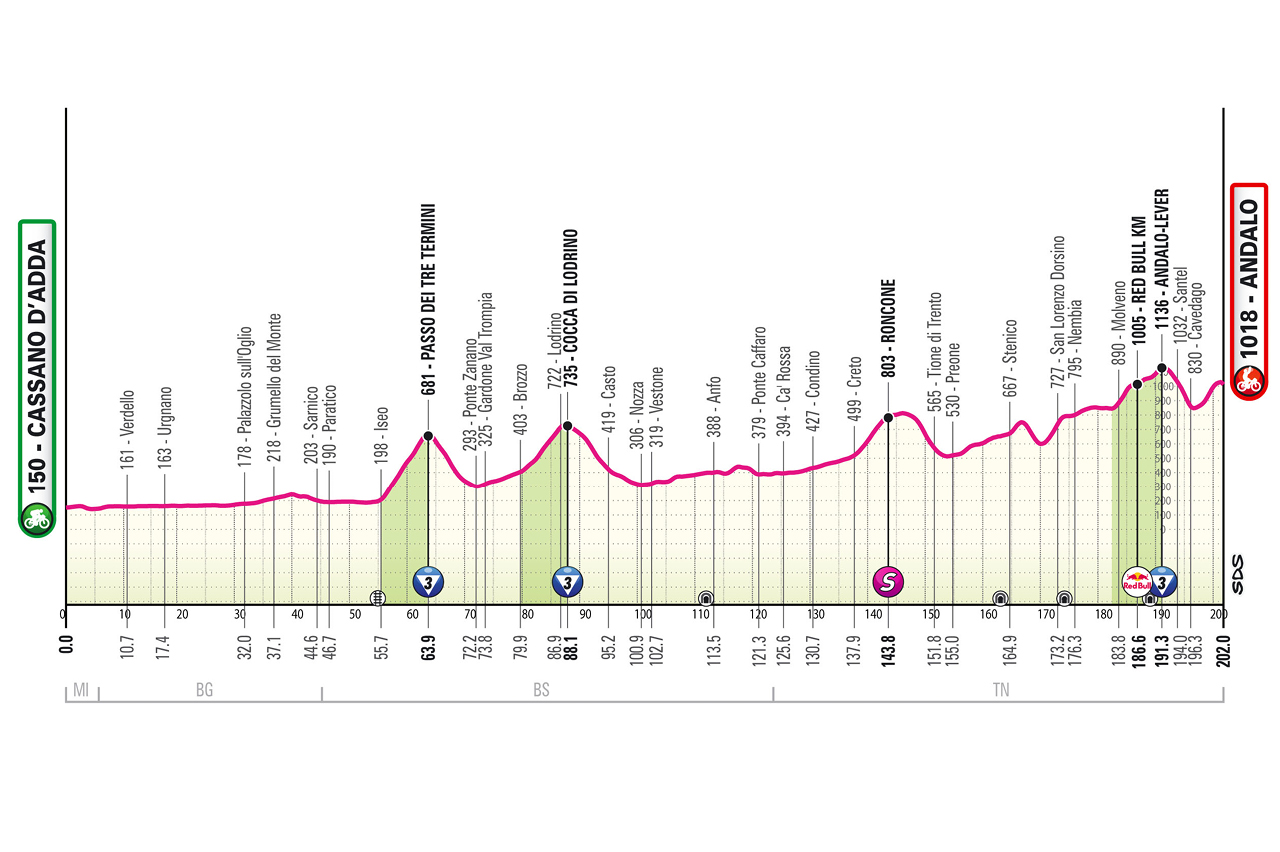
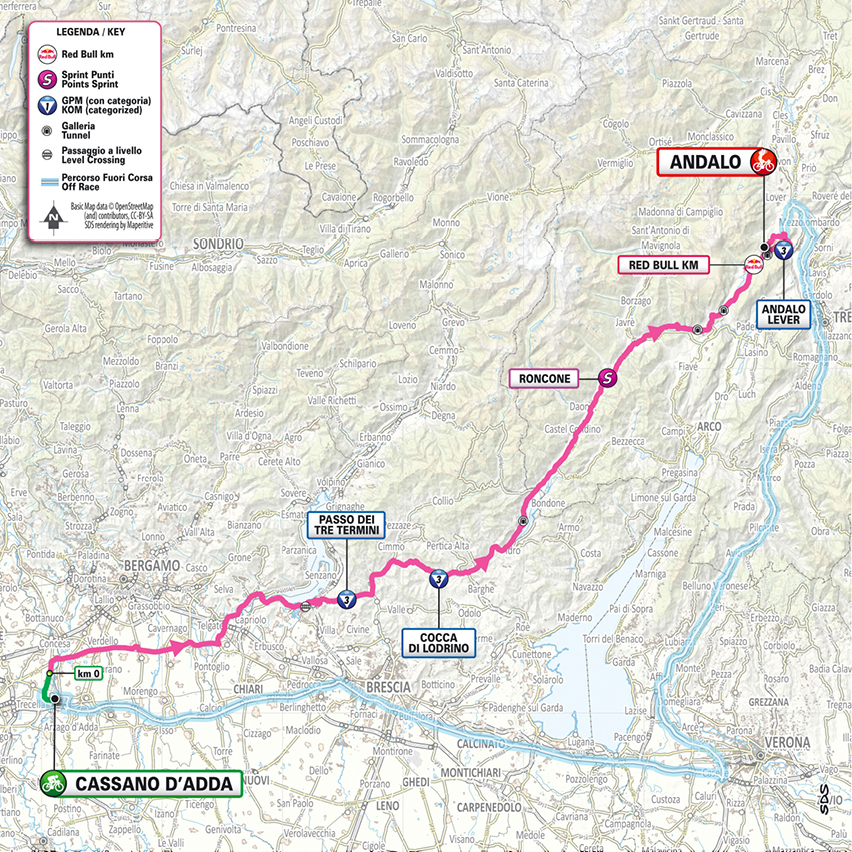
Rolling stage without particularly severe climbs. The approach to Lake Iseo is flat. After Iseo, riders tackle first the Passo dei Tre Termini and then the Cocca di Lodrino, entering the Valle del Chiese on a steady and gradual ascent. After Tione di Trento, the road becomes more technical, with a narrower carriageway, until San Lorenzo Dorsino, where the climb begins towards Molveno and then Andalo, leading into the final part of the stage.
Final kilometres
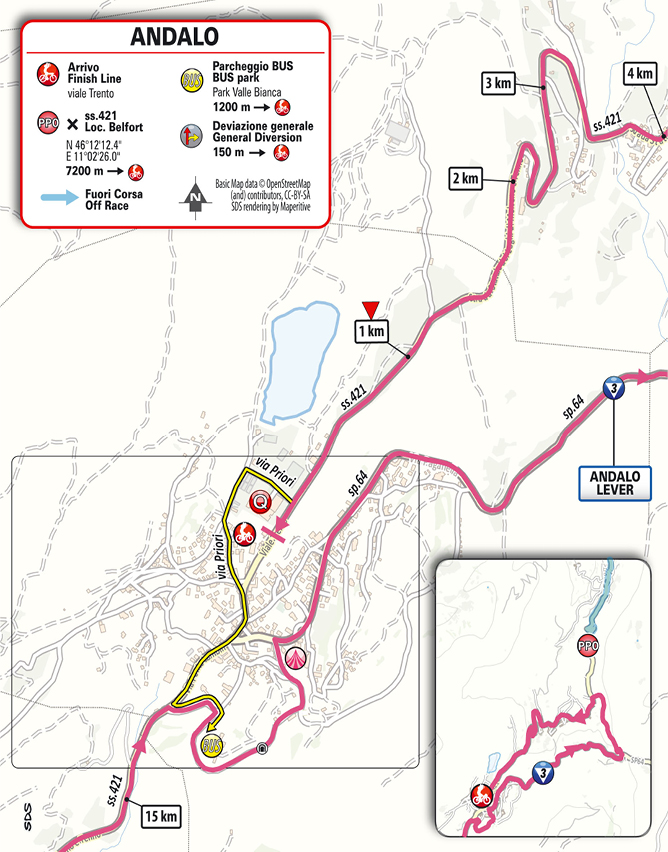
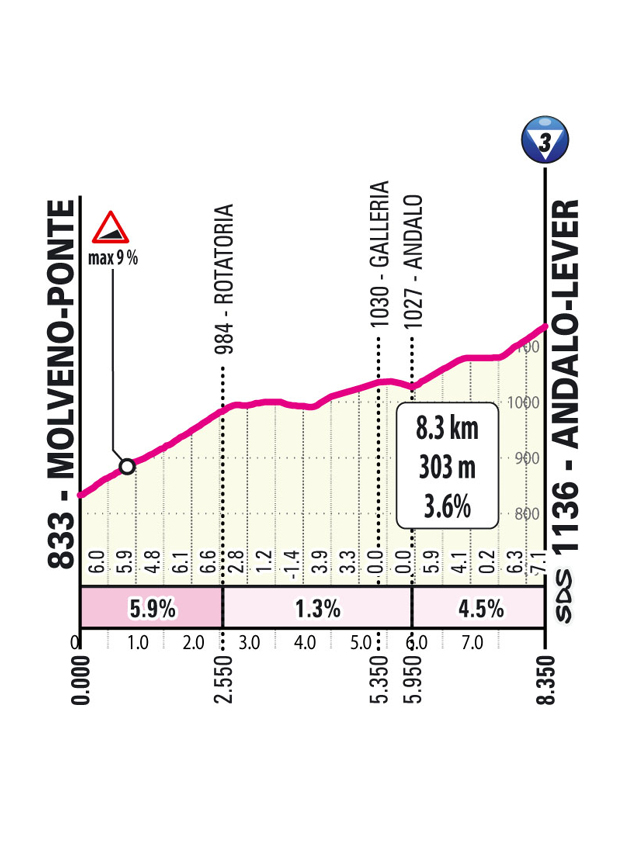
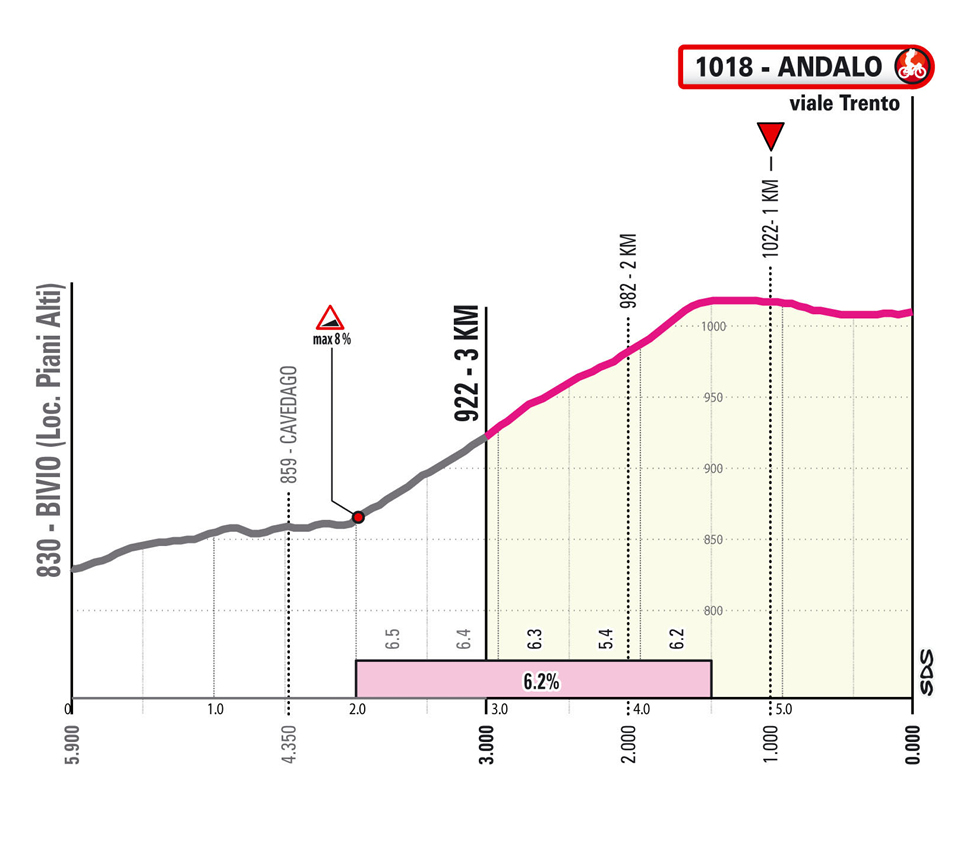
The final 11 km are clearly divided into two distinct sections. After the KOM at Andalo-Lever, there is a fast descent on a wide road, in parts with steep gradients. This is followed by 6 km of climbing: initially gentle, then more sustained, ending at 1.5 km from the finish. A slight downhill false flat leads into the final flat straight. Finish on 8 m wide asphalt, with a 700 m finishing straight.

start / finish

final kilometres

itinerary timetable

Strava Route

  • profile
  • map
  • technical info
  • start / finish
  • final kilometres
  • itinerary timetable
  • Strava Route
Save the dates of your favorite races and receive all the informations about the races

tourist info

Host city:

start
finish

Cassano d'Adda


Overview

Set along the course of the Adda River, Cassano d’Adda is a town in eastern Lombardy, now part of the Metropolitan City of Milan. Its history is closely tied to its strategic position on the river, which for centuries served as a natural boundary and a key route for communication and trade. The urban fabric preserves traces of its medieval past, including the Visconti Castle, while the surrounding area is marked by historic waterways such as the Naviglio della Martesana.

Gastronomy

Cassano d’Adda’s cuisine sits firmly within the rich tradition of Lombardy – hearty, comforting, and full of bold flavors. Risotto is a staple, often infused with saffron and enriched with sausage, alongside ever-present polenta. Classic dishes like cassoeula – a slow-cooked mix of pork and cabbage – and tripe, including the foiolo variation, reflect a rustic culinary heritage. More local specialties include rustida and curada, traditional offal dishes cooked in butter, and coniglio alla cassanese, rabbit stewed to tender perfection. For dessert, the star is paciarèla, a humble yet delicious cake made from stale bread, cocoa, raisins, and pine nuts, still celebrated today during the town’s festival, where tradition comes alive through food.

Vins et autres boissons

Cassano d’Adda once boasted a thriving winemaking tradition, with historical references to the vernaciuola di Cassano appearing as early as the 16th and 17th centuries. The surrounding countryside, especially around Groppello, was particularly suited to vineyards, producing wines that even reached the tables of Milan’s archbishops, transported along the Martesana Canal. The phylloxera crisis of the late 19th century brought this flourishing culture to a sharp decline, yet traces survived in the form of ciarinetu, a light, young wine produced for family consumption well into the 20th century – an echo of a once vibrant viticultural past.

Highlights & Landmarks

Cassano d’Adda rises on a rocky outcrop overlooking the Adda River, where the water branches into a network of irrigation canals that have long nourished the surrounding plains. The relationship with water defines the town: scenic cycling and walking paths trace the riverbanks, offering picturesque views of both nature and historic architecture. Dominating the skyline is the Visconti Castle, documented as early as 877 and later expanded by the powerful Visconti and Sforza families – its quadrangular form and massive bastions still conveying strength and authority.

In the heart of town stands Palazzo d’Adda-Borromeo, an elegant noble residence reshaped in the 18th century by leading architects of Lombard Neoclassicism and once host to Napoleon himself.

Nearby, Villa Brambilla overlooks the Adda plain, with frescoed interiors by the Galliari brothers and gardens that slope gently toward the Muzza Canal. The religious heritage includes the Church of San Dionigi, enriched with fresco cycles and stucco decorations, and its distinctive bell tower commissioned in the 14th century by Regina della Scala.

The Martesana Canal, a masterpiece of Sforza-era hydraulic engineering, once connected Milan to the countryside and remains lined with tree-shaded paths and historic scenery.

The largely pedestrianized historic center unfolds around a series of connected squares and preserves the layout of the ancient Ricetto, once used for storage and military quarters, now transformed into homes – streets where everyday life, architecture, and memory blend into a uniquely Lombard atmosphere.

Andalo


Overview

Set on the Paganella Plateau at the foot of the Brenta Dolomites, Andalo is a mountain resort in Trentino renowned for its long-standing tourist tradition. The village lies at over 1,000 metres above sea level and is set in an open natural environment characterised by meadows, forests and panoramic views of the main Dolomite peaks. Historically linked to agriculture and livestock farming, Andalo experienced significant development during the 20th century as a centre for both summer and winter tourism, thanks to the Paganella ski area and a well-developed network of sporting and hospitality facilities.

Gastronomy

The gastronomy of Andalo and the Paganella plateau is rooted in Trentino’s mountain tradition – honest, local, and deeply connected to the land. At the heart of it all is tortel di patate, made with the Kennebec potato and so iconic it even has its own brotherhood. The area thrives on agriculture, especially apples, berries, and honey, thanks to a strong beekeeping culture. Local specialties also include the prized white asparagus from Zambana and alpine char, a freshwater delicacy that reflects the region’s lakes and streams. Alongside these, craftsmanship shines through in artisanal products and even locally roasted coffee, where tradition meets quality in unexpected ways.

Wine and other drinks

The Paganella area lies within the renowned Piana Rotaliana Königsberg, one of Trentino’s most important wine regions. Its flagship is Teroldego Rotaliano DOC, a bold and expressive red shaped by unique soil conditions. Alongside it grow varieties such as Lagrein, Merlot, Cabernet, Pinot Noir, and Schiava, as well as native grapes like Nosiola. White wines are equally prominent, with Chardonnay, Sauvignon, Pinot Grigio, and Müller Thurgau offering fresh, aromatic profiles. The region also has a strong tradition of grappa, alongside apple juices, ciders, and locally brewed craft beers, each reflecting the alpine environment in its own way.

Highlights & Landmarks

Set on the Paganella plateau, Andalo is an alpine destination where nature, sport, and tradition come together against a stunning Dolomite backdrop. A key hub is Andalo Life, a modern sports and leisure center offering everything from swimming pools and an ice arena to climbing areas, wellness spaces, and multi-sport facilities designed for year-round activity.

The town itself retains traces of its medieval origins along the ancient Imperial Road, with its layout shaped by historic farmsteads (masi) that can still be explored along a scenic circular route. A defining natural feature is Lake Andalo, a karst lake that changes with the seasons, perfect for relaxing walks in summer and cross-country skiing in winter. Towering above it all is Piz Galìn, an iconic peak of the Brenta Dolomites, long tied to alpine farming traditions.

For families and nature lovers, the Sarnacli Mountain Park offers an immersive forest trail with interactive experiences, creating a direct and sensory connection with the mountain environment.

Follow us
#giroditalia

top sponsor

institutional partners

official suppliers

official licensees