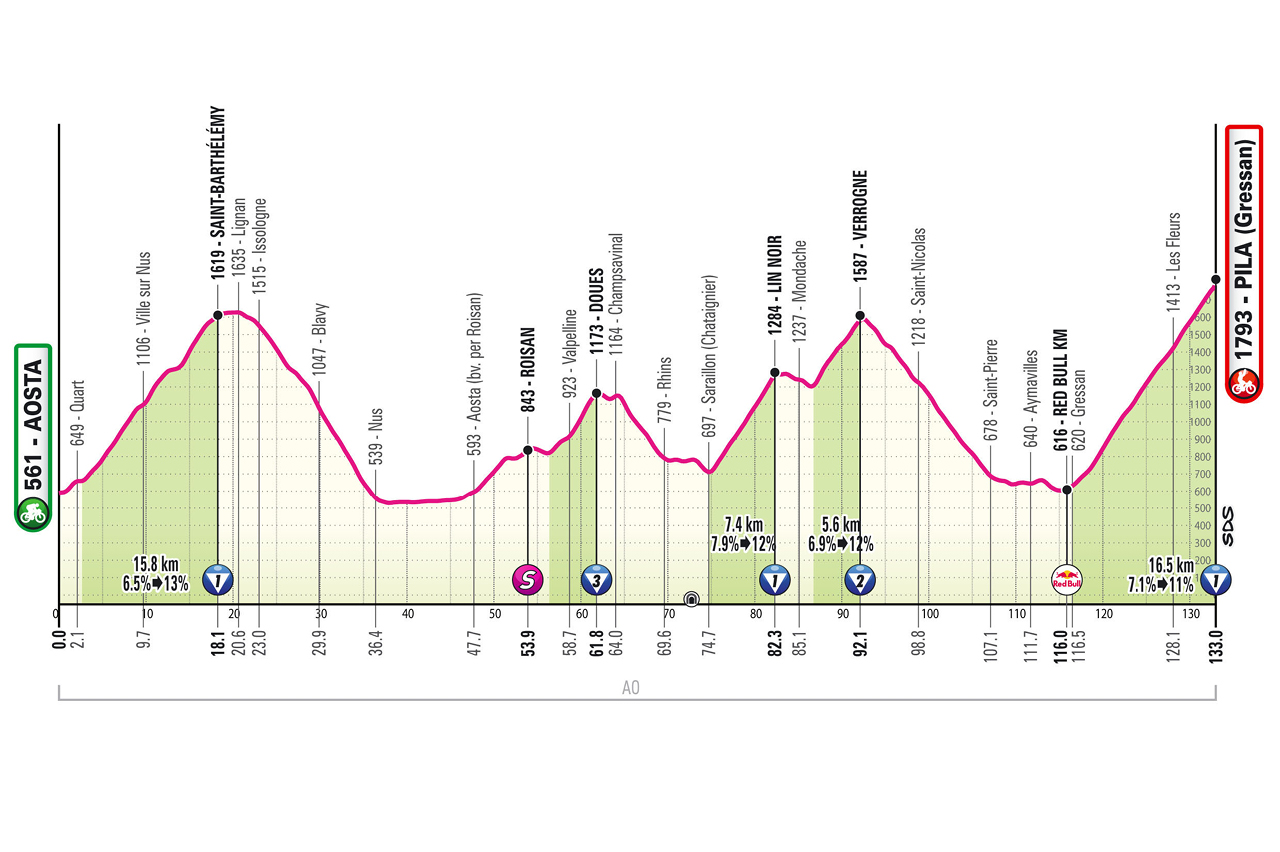
A brutal Alpine stage made up of an almost uninterrupted sequence of climbs and descents, with barely a moment to breathe in between. Right from the start, the riders tackle the long ascent of Saint-Barthélémy (Category 1, 15.8 km at 6.1%), followed by a wide and fast 20 km descent. After a short run back towards Aosta, the race heads straight into the Valpelline Valley, culminating in Doues (Category 3, 5.8 km at 6.2%), the easiest climb of the day.
Back near Aosta, the peloton then takes on Lin Noir (Category 1, 7.4 km at 7.9%) and Verrogne (Category 2, 5.6 km at 6.9%), separated only by a very short descent, before dropping back into the valley for the final climb to Pila (via Gressan).
The final ascent — 16.5 kilometres at an average gradient of 7.1%, with ramps peaking at 9% — is a steady but demanding climb, worthy of a grand Alpine setting. On a clear day, the summit offers views of some of the most iconic peaks in the Alps: Mont Blanc, the Matterhorn, Monte Rosa and Gran Paradiso.
Pila has already written important chapters in Giro history, particularly during the 1980s and 1990s, although in the past the race always climbed the Pont-Suaz side. This time, however, the riders will ascend what traditionally served as the descent route. In 1987, Robert Millar triumphed ahead of Marino Lejarreta and Maglia Rosa Stephen Roche, while in 1992, Udo Bölts won from the breakaway in an edition eventually claimed by Miguel Indurain.