

profile
map
technical info
Route
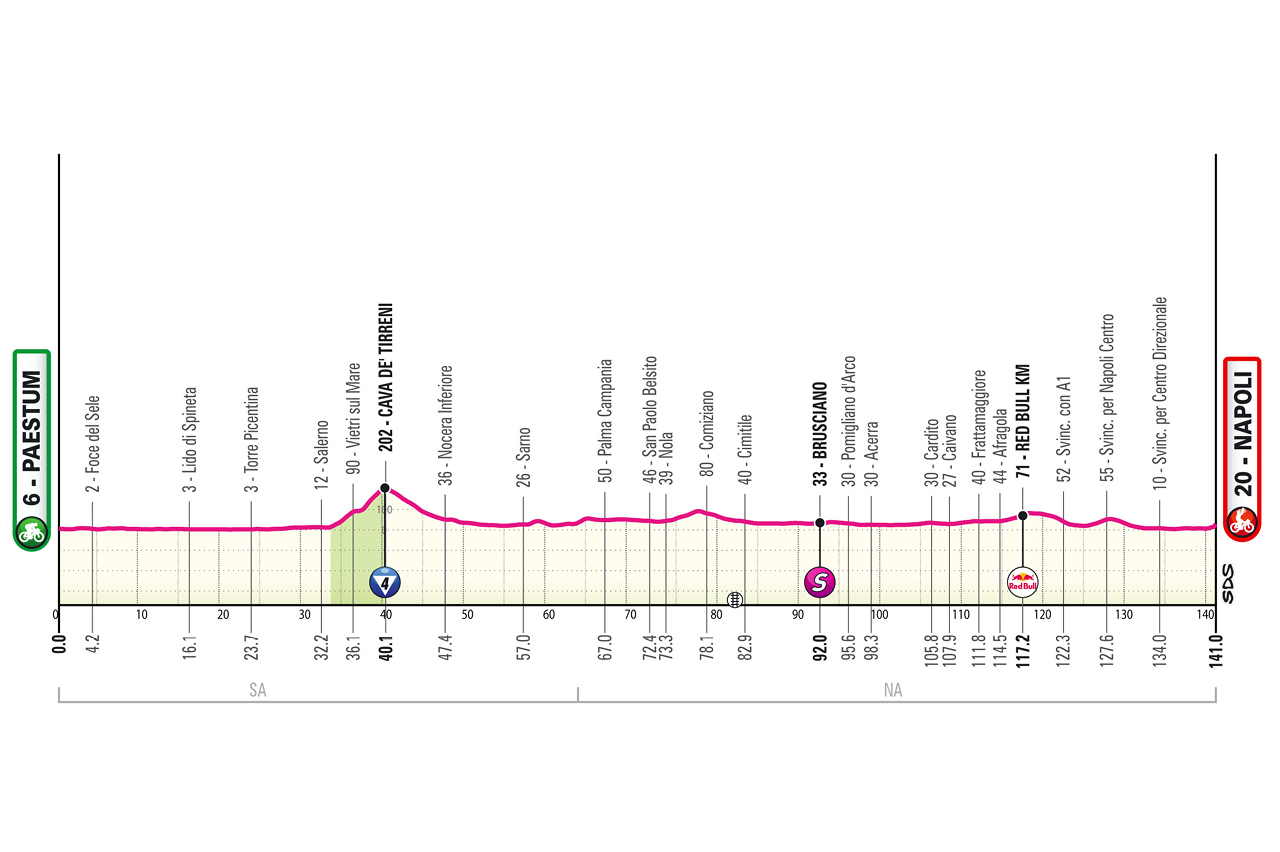
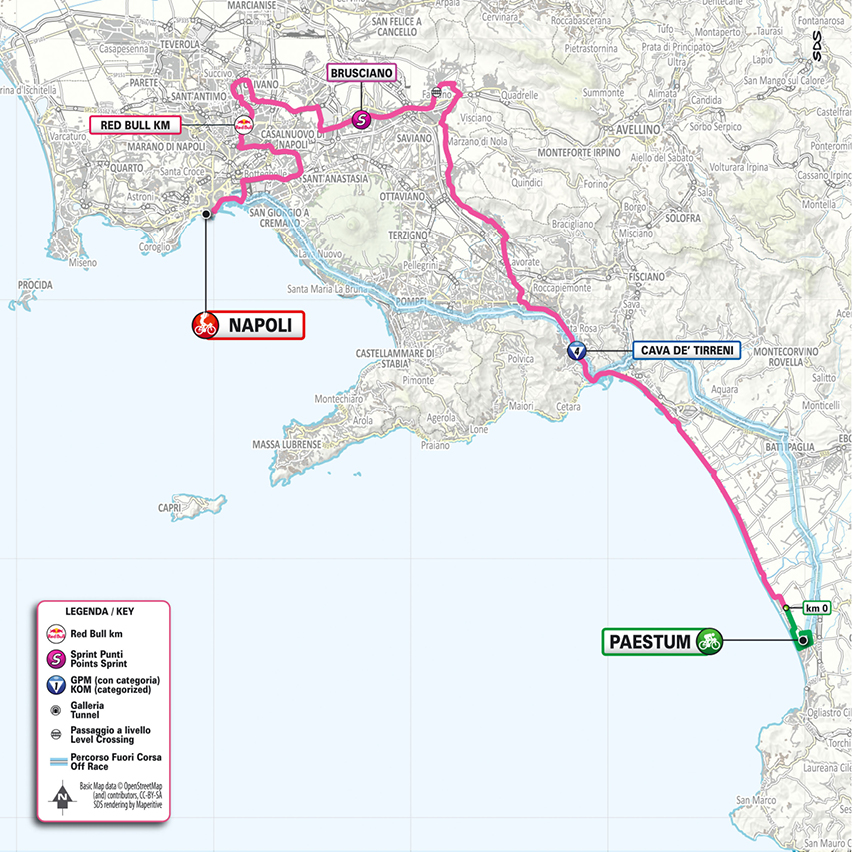
Short and flat stage. The first part runs along the Tyrrhenian coast to Salerno, where the route climbs to Cava de’ Tirreni (the only KOM of the day) before entering the plain around Mount Vesuvius. After Nola, the final 70 km are entirely urban, with a near-continuous succession of built-up areas (and therefore the typical features of obstacles and street furniture). Before entering Naples, around 20 km are covered on a dual carriageway. The finale takes place within the city of Naples on wide, paved roads.
Final kilometres
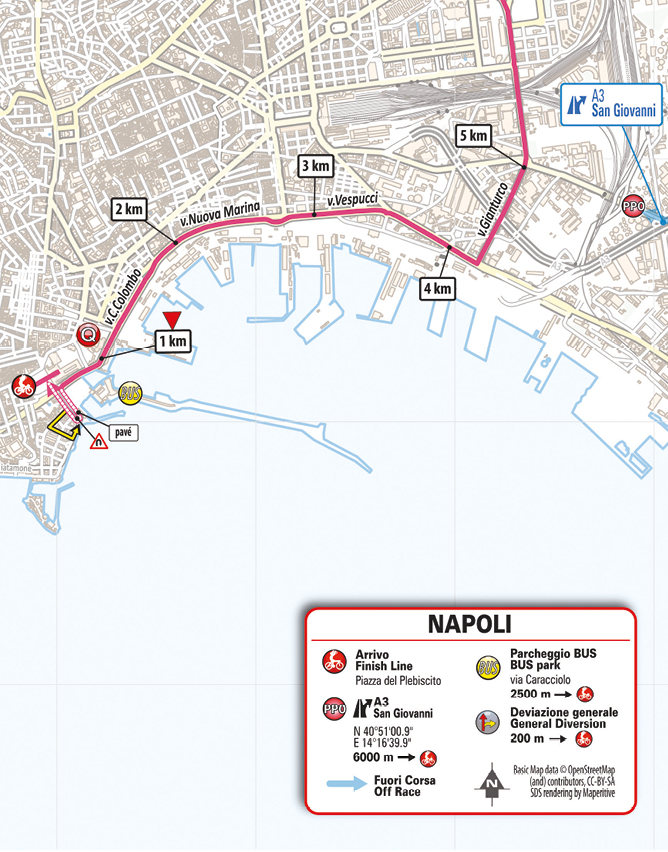
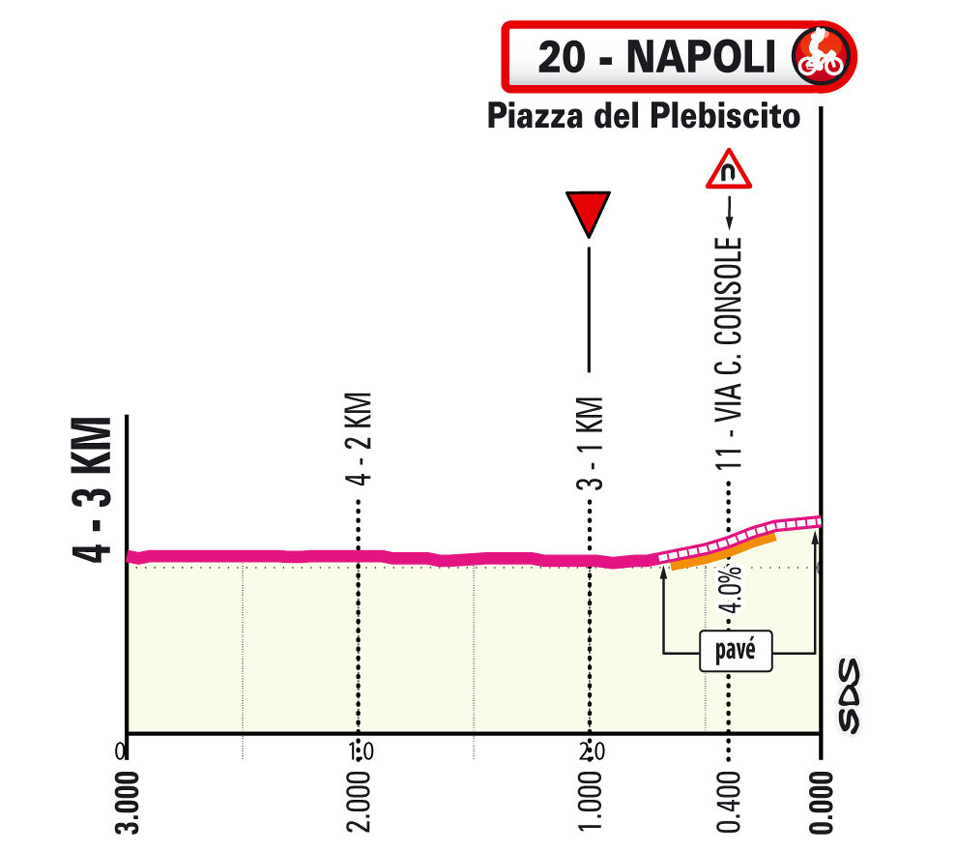
The final 3 km are virtually straight along the port. At 650 m from the finish, a left-hand bend leads onto the slight uphill (4%) of Via Acton on stone slabs. At 400 m, two right-hand bends lead onto the final straight on 8 m wide cobbles.
start / finish

final kilometres
itinerary timetable

tourist info
Host city:
Paestum
Overview
Located in the Sele Plain in Campania, Paestum is a hamlet of the municipality of Capaccio Paestum and is renowned for its extraordinary Greek archaeological site. Founded in the 6th century BC under the name Poseidonia, it later became a Lucanian and then a Roman city, passing through different historical phases that enriched its heritage. The area preserves three large Doric temples, among the best preserved in the Mediterranean, along with remains of city walls, dwellings and public spaces. The historical and monumental value of the site has led Paestum to be recognised as a UNESCO World Heritage Site.


Points of interest
The archaeological site at Paestum is located in the municipal territory of Capaccio Paestum. The temple of Athena (the so-called temple of Ceres), built in the late 6th century B.C., is the highlight of the northern sacred area. The southern sacred area contains two Doric temples, the so-called Basilica (dating from 530 B.C.) and the temple of Neptune (mid-5th century B.C.), which are regarded as the finest examples of Greek architecture in the western world. The National Archaeological Museum in Paestum contains relics from the town and its surroundings, including a slab with a fresco of a man diving (‘Il Tuffatore’), the only sample of Greek painting found in Magna Graecia. Paestum’s surroundings offer a long sandy beach lined with summer clubs, and a pine forest that is the perfect place to do some jogging or have a walk.


Napoli
Overview
Naples is one of the most populated towns of Italy and there are almost one million inhabitants.
Since from the Ancient time, it has been a multicultural town, a destination longed for by many polpulations who have succeeded in time and have shaped its aspect and culture.
Walking in the heart of the old city is retracing the town history. In fact, through the long and characterisic streets, the churches architectures and ancient nobiliary buildings are evident different stratifications that show different historical and artistic influences. In fact in 1995 the historical center of Naples was declared from UNESCO “world cultural heritage”. Among the most famous streets there is Spaccanapoli, a very long street that, if seen from the top of Vomero hill, seems to split in two the historical centre. Then there is Saint Gregorio Armeno street that is famous for the artisan shops of nativity scenes. A stop-over in the cathedral is suggested to see the chapel of Saint Gennaro considered one of the masterpieces of the baroque art.


Food
If any food should be associated with Naples, it would definitely be pizza: the classic and most famous “pizza Margherita”, topped with mozzarella cheese, tomatoes and a leaf of basil, has been joined by many new and refined “gourmet” recipes, recently in vogue and able to suit all tastes. Pizza, in Naples, is a “serious matter” and the job of “making it” is considered as pure art: that is why nothing is improvised, and its preparation is made of precise gestures and procedures, wisely handed down from one artisan to another. In fact, in 2017 the “art of Neapolitan pizza-makers” was declared “Intangible Heritage of Humanity” by UNESCO, thereby recognising pizza’s cultural relevance and identity value as a “Neapolitan (quality) brand”.
However, visitors willing to enjoy the flavors of traditional Neapolitan cuisine must prepare to be spoilt for choice! Among other typical products, a very tasty one is “casatiello”, a sort of “rustic pie”, made of a dough mixed with pepper and lard and filled with eggs, salami and cheese, traditionally prepared for Easter.
Actually, even Neapolitan pastry offers plenty of delights; sweet lovers can not miss a stop in a traditional pastry-shop to taste one of the local delicacies: the famous “Babà”, offered by every café and restaurants, either in its classic rum-flavored recipe, or covered in custard, cream or chocolate; still, the traditional “Sfogliatella”, a pastry with a delicious filling of semolina, ricotta cheese, eggs, sugar, candied fruit cut into small pieces, either wrapped in a shell-shaped crunchy puff pastry (the so called “riccia”) or surrounded by a round-shape thick shortbread (“frolla”) Babà and Sfogliatella flavoured ice cream definitely deserves tasting too.


Beverages
Coffee is one of the symbols of Naples. Appreciated for its restoring property it is more than a simple beverage. Offering a cup of coffee or simply drinking it has a symbolic value, it’s a kindness, it’s an act of friendship. Coffee is an opportunity for shortening distances and engaging a conversation. In Naples there is the custom of “caffè sospeso”: when you take a coffee in a bar you can pay for an other coffee than is destinated to an other customer who will ask for. In this way is offered to a person who can not afford the price of the coffee.
Although it is appreciated in all its varyties the most traditional manner to prepare the coffee is using the so-called “cuccuma” the typical neapolitan coffee maker. It’ is composed of two overlapped containers. One is fill up with water and the other one with coffee powder. When the water boils, it is necessary to overtun the coffee maker in order to make water filter through the coffee powder. During this procedure it’s better to cover the spout of the coffee maker with a “coppettiello” that is a piece of paper fold as a cone in order to preserve the coffee aroma. It is taught by Eduardo De Filippo in his famous comedy “Questi fantasmi”.
Points of interest
More and more people, from Italy and all over the world, plan to visit Naples every year. Its historical and cultural heritage makes Naples one of the top tourist destinations. Its several churches and museums, its typical alleys, and its ancient nobile buildings, tell us about two thousand-years of history, rooted in a crossroad of people and civilizations that deeply influenced the local culture and features.
Though, Naples captivating beauty does not come exclusively from its long history. This place is also fertile ground for innovation and creativity. A significant event has been the recent opening of Line 1 – Metro stations, the so called “Art Stations”. These stations have been designed by renowed architects (such as Alvaro Siza, Gae Aulenti, Massimiliano Fuksas, Karim Rashid, Alessandro Mendini, Oscar Tusquets Blanca) and great contemporary art-works have been placed within them. Not surprisingly, they are called “compulsory museums”, since daily passengers cannot avoid to look at the contemporary artworks displayed there, as well as to admire the city’s ancient greek and roman ruins, emerged from the metro line’s costruction sites.
Likewise, in its traditional “vicoli” (narrow and shadowy alleys), Napoli bursts with art and beauty. In the renowed, popular districts of “Quartieri Spagnoli” (“Spanish Quarter”) and “Sanità”, special tours are arranged to discover the many graffitis, and site-specific artworks recently appreciated, such as the street-artist Jorit, whose trademark is a powerful, almost photographic, realism in portraying famous people linked to Neapolitan history and culture. Among them, stands out the portrait of San Gennaro, city’s Patron Saint, depicted on the facade of a popular building, just a short walk from the Cathedral where his relics are preserved.
The underground city is very interesting too. It is possible to visit ancient tufa quarries that in the past where used as cisterns and also as shelters during the Second World War.
People who arrive in Naples have also to visit the hill districts. In Vomero it is possible to see the Charterhouse of San Martino or the XVth century Castle of Sant Elmo from which is possible to admire the city from above. Another panoramic point of the city is the hill of Posillipo. From here tourists can appreciate the Gulf of Naples and Sorrento coast.