





profile
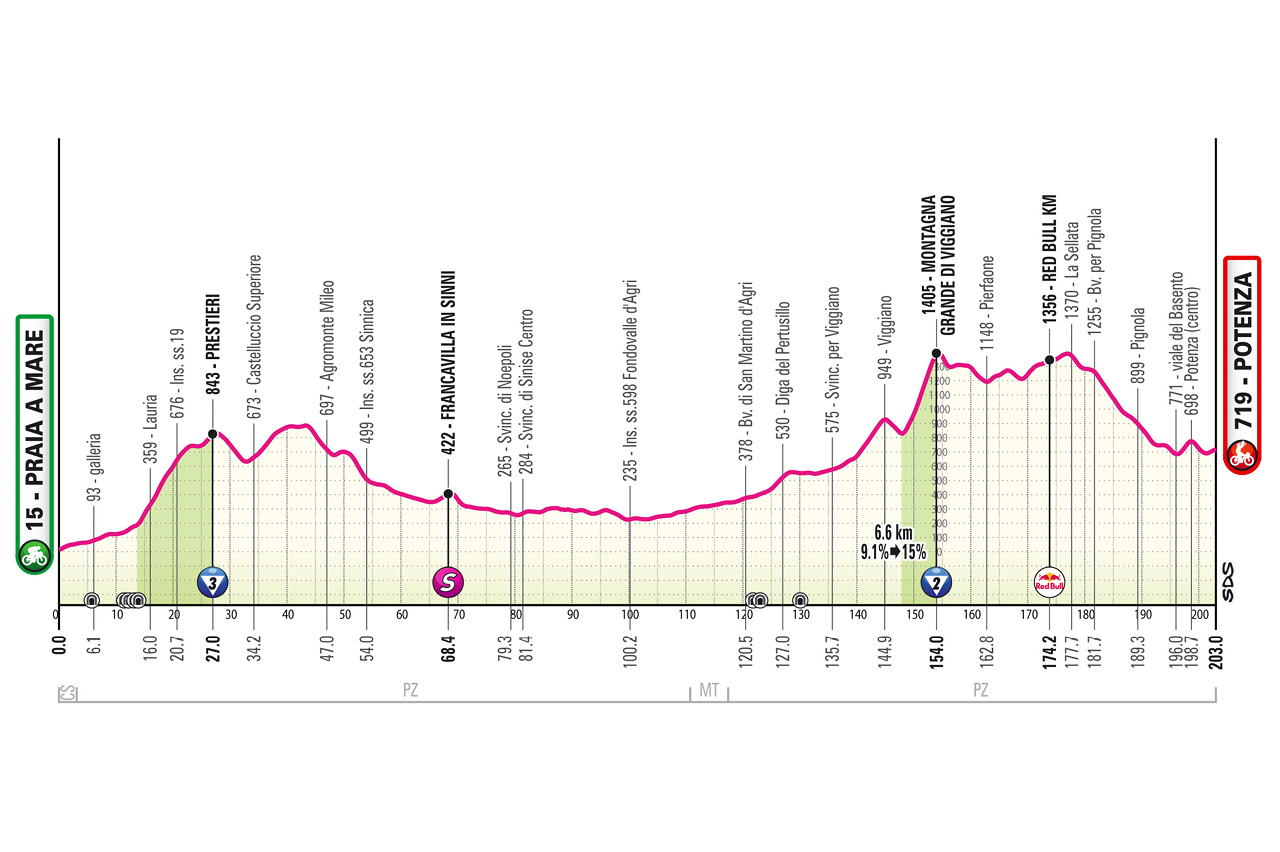
map
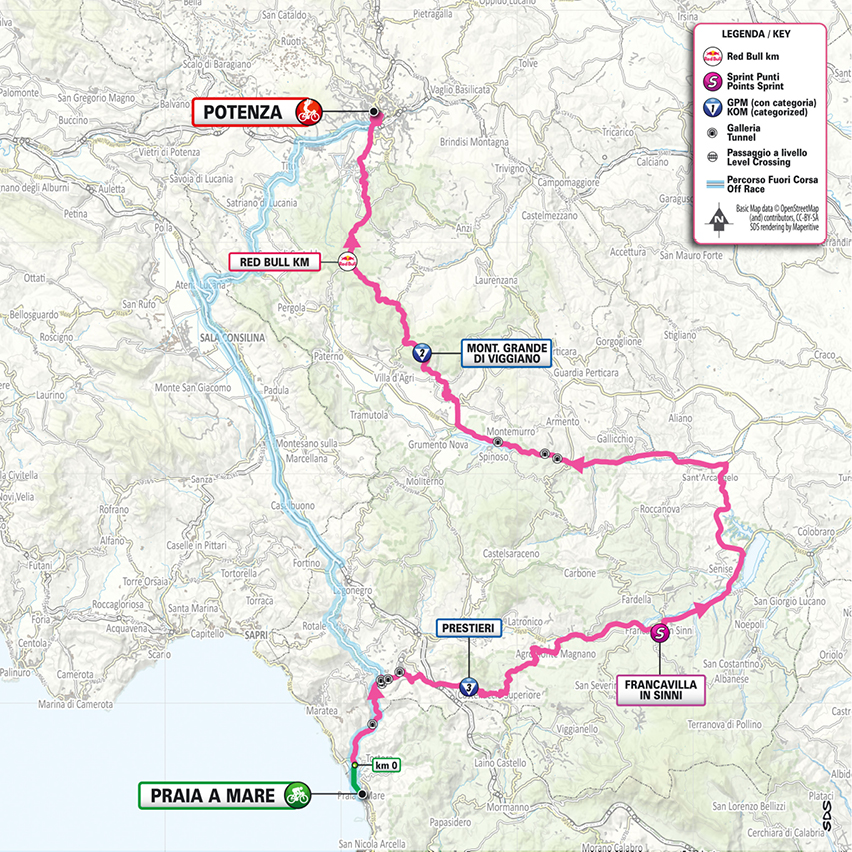
technical info
Route
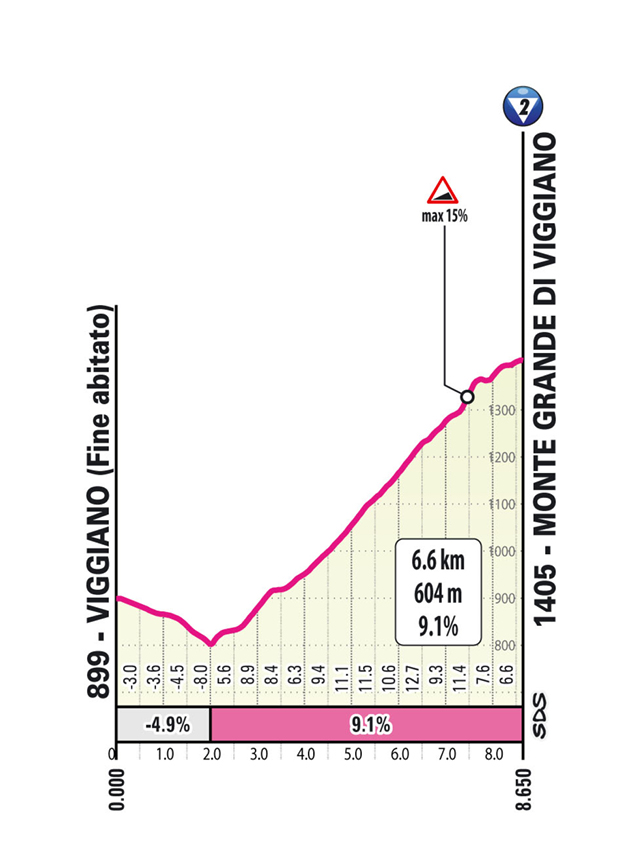
Very demanding stage, entirely inland between Calabria and Basilicata. Right from the start, the route climbs into the Pollino National Park with the Prestieri KOM (over 12 km long, but without major gradients). The race then follows the Sinni valley, mostly descending but with several false flats, especially through the towns. After Francavilla in Sinni, the stage moves into the Agri valley towards Viggiano, where riders tackle the hardest climb of the opening stages of the Giro: Montagna Grande di Viggiano (6.6 km, max 15%), leading into the Pierfaone ski area, followed by rolling terrain before the descent to Potenza.
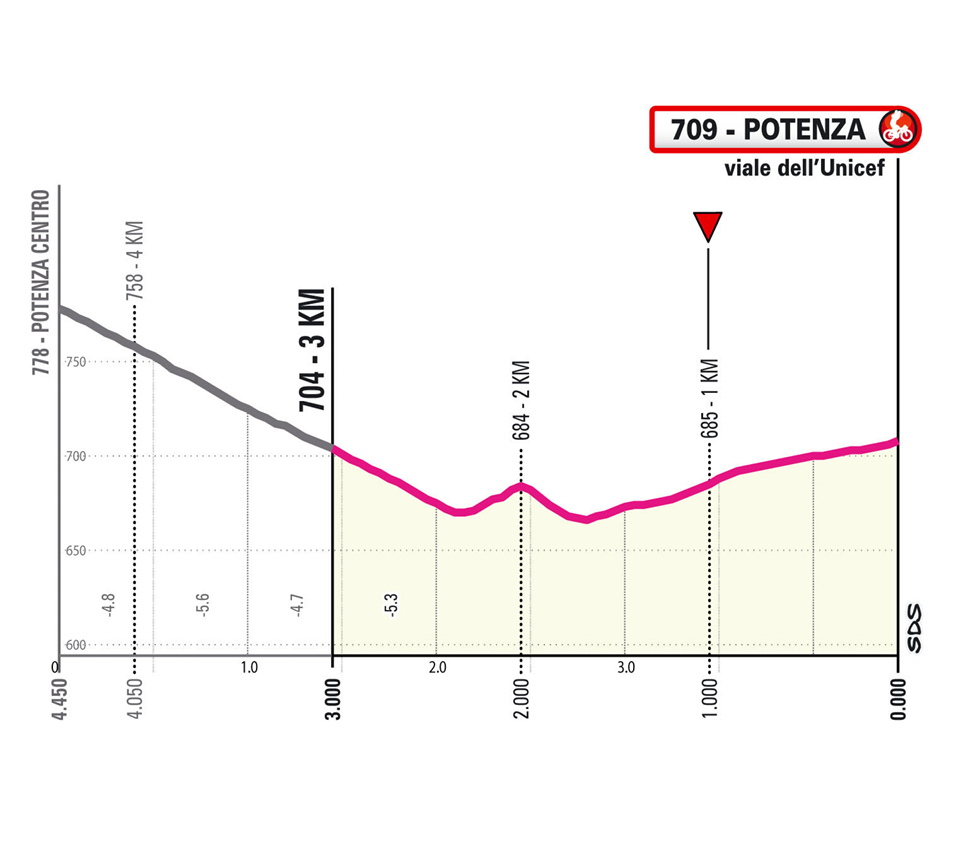
Final kilometres
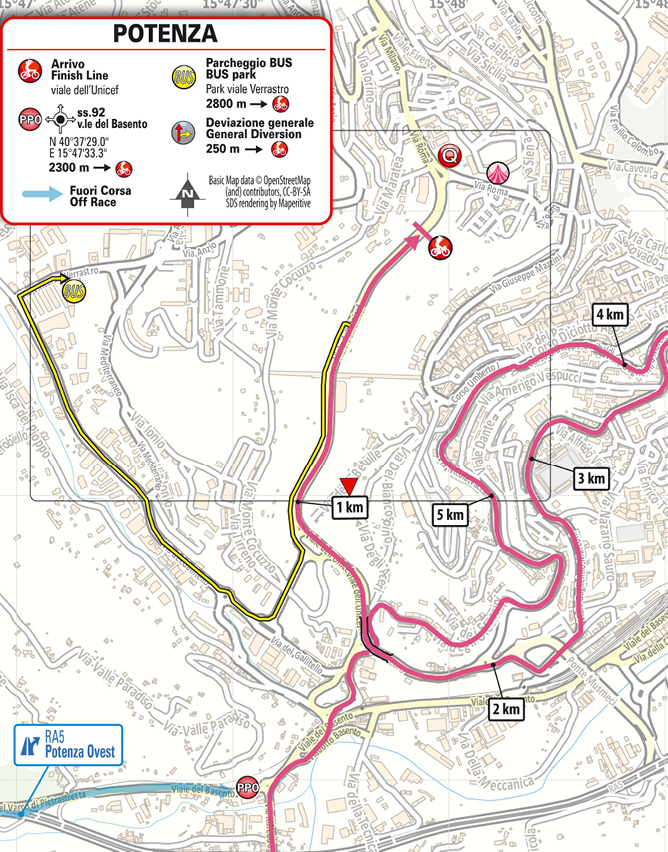
The final kilometres are first characterised by a climb through the centre of Potenza, followed by a descent leading into the last kilometre. Overall, the finale trends slightly uphill (around 2–5%). Final straight of 700 m on a slight rise (asphalt surface, 7 m wide).
start / finish

climb detail
final kilometres
itinerary timetable

tourist info
Host city:
Praia a Mare
Overview
Overlooking the Tyrrhenian Sea, Praia a Mare is a town in the province of Cosenza, located in the far north of Calabria, close to the border with Basilicata. The town stretches along a section of coastline known for its beaches and for the presence of Dino Island, which gives the seascape a distinctive character. The municipal area extends from the coastal strip toward the first foothills of the southern Apennines, near the Pollino National Park. Praia a Mare experienced most of its development during the 20th century, establishing itself as a key tourist destination along the Riviera dei Cedri.
Potenza
Touristic Information
The capital of Basilicata for over two centuries, Potenza is the highest regional capital in Italy at 819 metres above sea level. Elegant and welcoming, the city revolves around its thousand-year-old historic centre, made up of old and new buildings that climb up on the hill, ancient gateways and medieval towers, historic stone staircases and modern escalators, stately palaces and authentic little squares, narrow alleys and cobbled streets, as well as museums and art galleries, such as the “Dinu Adamesteanu” National Archaeological Museum, housed in the historic Palazzo Loffredo.
In the central Piazza Mario Pagano, recently renovated on a design by the famous architect Gae Aulenti, stands the theatre dedicated to the Potentine musician Francesco Stabile, built in 1857 in the image of the San Carlo theatre in Naples.
In May, then, the city is enveloped in a magical atmosphere that revolves around the preparations for the celebrations in honour of its patron saint, San Gerardo Vescovo da Piacenza, celebrations that are intertwined with the historic Parade of the Turks, a parade that retraces the crucial moments in history, loudly narrated by entire generations of the capital, which sees the city’s patron saint repel with a blinding glare the invasion of the Turks who silently came up the Basento river.


Gastronomy
Basilicata’s traditional cuisine features a broad variety of specialities: From strascinati, homemade pasta served with tomato sauce or in other delicious and unmissable recipes, to flavourful cheeses, produced by traditional methods, such as Pecorino cheese of Filiano (PDO), Canestrato of Moliterno (PGI), ricotta, scamorza and caciocavallo (gourd-shaped cheese), and to pork sausage, such as the “lucanega” variety, already known in ancient Rome. Matera bread (PGI), with its fragrant flavour and characteristic shape that reminds Murgia landscapes, is really worth trying. Other delicious specialties include: black, oven-dried olives from Ferrandina area, baccalà (dried salt-cured cod) from Avigliano, optimum mineral waters from the springs of Mount Vulture, Rotonda red eggplant PGI, Sarconi bean PGI and Senise pepper PGI. Fresh seasonal fruit is a recurrent motif on the table: citrus fruits, strawberries, peaches, pears and grapes are only some of the varieties cultivated on the plains around Metaponto.


Beverages
In Basilicata, when you sit down to eat, you combine the flavour of unique specialties, seasoned with a drizzle of “Vulture” DOP Extra Virgin Olive Oil, with a delicious, full-bodied, intense and smooth wine. In fact, one of the best wines in southern Italy comes from the hills of Vulture: Aglianco del Vulture DOC.
The origins of this fine wine, which today is counted among the best in Italy and Europe, date back to the times of Magna Graecia. The vineyards are located on the slopes of Monte Vulture, an extinct volcano that gives the wine its unique and distinctive character. Aglianico del Vulture, whose “Superiore” variety was awarded DOCG status in 2010, is the perfect accompaniment for the highly regarded local cuisine and strong traditional flavours.
Basilicata boasts 3 other wines bearing the DOC mark and well representing the regional variety: “Terre dell’Alta Val d’Agri” wine, produced in the Val d’Agri district and available in Red, Red Riserva and Rosè varieties; “DOC Matera”, which takes its name from the town of Sassi but is also produced throughout the province, from the Ionian Coast to the Murgia gorges; “Grottino di Roccanova”, named after the ancient caves where the wine is traditionally aged.
Main sights
POTENZA – The “Dinu Adamesteanu” National Archaeological Museum
The Museum is located in the prestigious Palazzo Loffredo, the most important historical building in Potenza, which also houses the Municipal Gallery and the Celestine Chapel.
Dedicated to Dinu Adamesteanu, a scholar of international renown and the “founder” of Lucanian archaeology, the museum is an important showcase for the regional museum network, consisting of eight national archaeological museums, to which the exhibition on the first floor is dedicated.
At the entrance you can admire the exhibitions: “Dinu Adamesteanu, the man and the archaeologist. From Dobruja on the Black Sea to Siritide on the Ionian Sea” and “Invitation to the Prince’s House. Archaeology in Tito, Satriano Tower”.
POTENZA – The Provincial Archaeological Museum
The museum exhibits archaeological finds from excavations in Basilicata with findings dating from prehistoric to late Roman times and extending into the Middle Ages.
On the ground floor it is possible to visit the archaeological exhibition “The eternal renewal of life; signs and symbols” with artefacts from the Neolithic to the Middle Bronze Age, from the Latronico Caves, and to admire part of an aedicula funerary stele with an Oscan inscription in Greek characters, from Anxia (Anzi).
The inner garden hosts a significant exhibition of the Lapidarium, with honorary and funerary inscriptions in Latin related to the Roman Potentia of the period between the Republican and Late Antique periods.
POTENZA – The Cathedral of San Gerardo
Built in 1197, the cathedral dedicated to the city’s patron saint stands on the remains of an early Christian basilica. Its current neoclassical appearance dates back to the end of the 18th century, designed by architect Antonio Magri, a pupil of Vanvitelli.
The main façade is very beautiful, with a fine portal with two bronze doors and a small rose window, probably belonging to the older church, dedicated to Our Lady of the Assumption until the middle of the 13th century.
The cathedral has a Latin cross plan with a single nave and ten chapels distributed around its perimeter, including one dedicated to Saint Gerardo la Porta di Piacenza, the patron saint of Potenza.
Upon entering this beautiful temple, one’s gaze is drawn to the exquisite frescoes decorating the vault by painter Mario Prayer (1933-1934). The crypt of the high altar is also of particular interest.
POTENZA – The Teatro Stabile
Listed among the region’s artistic places of excellence, the theatre dedicated to the Potentine musician Francesco Stabile was proclaimed a “Lucanian Historical Theatre” in 2014.
The attentive visitor will notice that the theatre was built in 1857 in the image of the San Carlo theatre in Naples. Despite numerous restorations, the building has retained its original decorations that, together with the harmonious interior structures, make it a gem of its kind.
The ground floor, three tiers of boxes and the gallery enclose the orchestra and the stage on which many important cultural events and theatre shows are staged.
POTENZA – The Guevara Tower
The three-storey, twenty-metre-high building is located in the old town centre and is all that remains of an ancient castle (10th-11th century).
Under the Guevara family, counts of Potenza, the castle was donated to the Capuchin friars. In 1810, when the castle was taken away from the monks, it began to undergo numerous changes in its use and structural modifications, until it was completely demolished in the 1960s to allow for the building of a school.
POTENZA – The Musmeci Bridge
A prestigious “gateway” to the city, the bridge is named after the engineer who designed it around the end of the 1960s. Looking at it closely, one immediately realises that it is reductive to call it an “ordinary” bridge and that it would be more correct to consider it as a gigantic and refined sculptural work.
It does not rest on pillars, but on concrete waves forming a single vault and four contiguous arches, and this conformation has allowed internationally renowned artists and sportsmen to perform using the engineering features of this masterpiece of contemporary architecture.
Potenza and its patron saint, San Gerardo La Porta
The patron saint of Potenza, and of its archdiocese, is St Gerardo La Porta, the bishop who is credited by the population with repelling the invasion of the Turks with a blinding glare. Over time, the episode has become the focus of the festivities held every year in honour of the Saint. A parade full of myths and legends that intertwine with historical facts, sometimes to the point of complete confusion, retraces the crucial moments of that event. The historic Parade of the Turks is a travelling performance that fills the streets of the city on 29 May every year, with hundreds of costumed figures playing the roles of the various protagonists of this re-enactment.