See all
See all
Save the dates of your favorite races Synchronize your calendars

Climbs and Time Checks: Andalo, Ca’ del Poggio, Giau, Piancavallo

02/05/2026

Giro d’Italia and TUDOR launch a news project aimed at mapping the climbs of elite cycling, building an archive of ascents that have shaped (and will shape) the history of the sport, while offering fans a time benchmark to compare themselves against.

Timing points will be set at the start and finish of 11 selected climbs over the three weeks. These timing points may coincide with the KOM banner or the stage finish. Today we present the final four climbs.

Andalo

Surrounded by peaks well above 2,000 metres, Andalo lies on a wide grassy saddle in the centre of the Brenta–Paganella plateau. The climb itself is not particularly demanding, but it is located very close to the finish – cresting just over 10 km from the line – and will likely serve as a launchpad for anyone aiming to win the stage. It starts in Molveno and ends at Andalo-Lever, covering 8.3 km of irregular climbing with an average gradient of 3.5%. A short descent then leads back onto the main road and straight towards the finish.


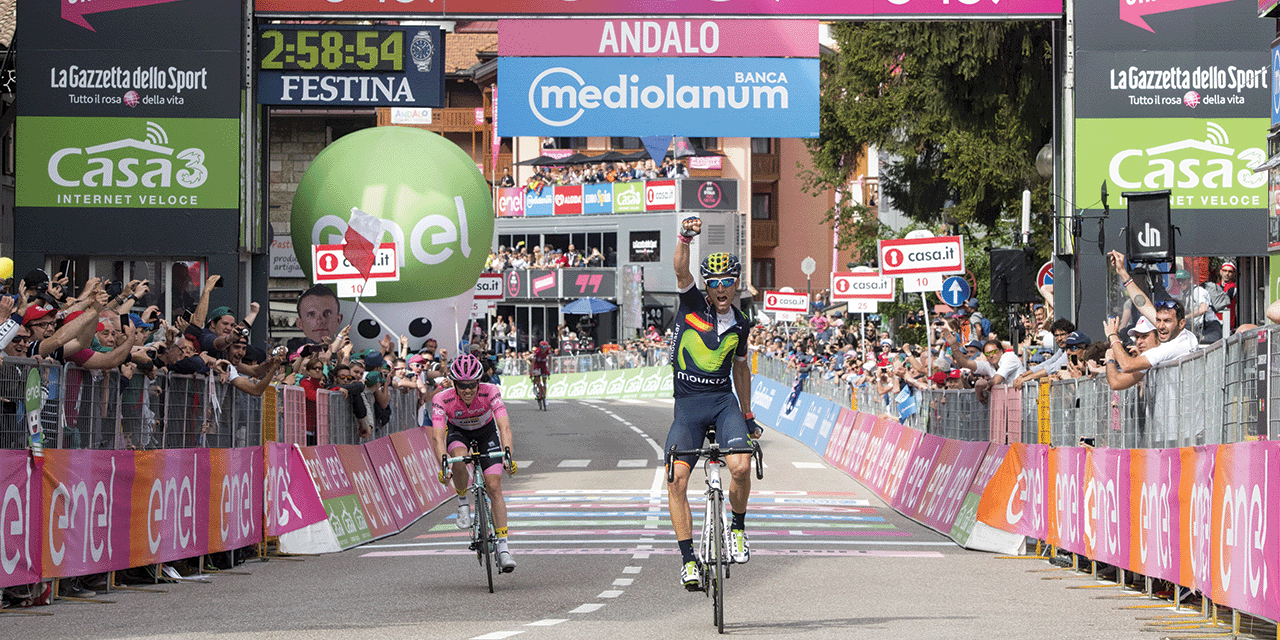
For Andalo, which has often hosted stages of the former Giro del Trentino and now the Tour of the Alps, this will be the third Giro d’Italia stage finish. The first dates back to 1973, the year Eddy Merckx wore the Maglia Rosa from start to finish, with the Belgian also winning solo in the Trentino resort. The second is more recent, in 2016, when Alejandro Valverde claimed his only Giro stage victory, beating Maglia Rosa Steven Kruijswijk in a two-man sprint, while Vincenzo Nibali cracked and lost nearly two minutes, time he would later recover in the dramatic final days.


In both previous occasions, however, the stage was far harder than it will be in 2026. The 202 km Cassano d’Adda–Andalo stage is likely to be a transition stage, suited to breakaway specialists.

Muro di Ca’ del Poggio

The Ca’ del Poggio Wall is not just a climb, it is a small theatre of cycling set among the Prosecco Hills, now a UNESCO World Heritage site. Located in San Pietro di Feletto, in the heart of the Treviso province, it is short and brutal: 1,150 metres at an average gradient of 12.3%, with ramps up to 19%.


Officially named in 2010, the Wall quickly became a symbol, also thanks to its twinning with northern giants such as the Muur van Geraardsbergen and the Mûr-de-Bretagne, with the ambitious idea of creating a European network of the most iconic “walls” in cycling. But it is above all the Giro d’Italia that has turned it into a cult location: repeated passages since 2009 have transformed this strip of asphalt into a popular festival, coloured pink and packed with fans.


Not only professionals: the Wall has also hosted the Giro U23, the Giro Women, and even the 2010 Italian Championships. Particularly notable was the innovative “real-time” time trial at the 2018 Giro U23: a pursuit-style effort on the climb and surrounding roads, with riders starting one after another according to their real time gaps in the general classification.

Passo Giau

When you reach the summit of Passo Giau and the view opens onto alpine meadows, wooden huts and the majestic Dolomite walls – with Nuvolau standing guard – visitors immediately understand why it is considered one of the most beautiful panoramas in the Alps. But to earn that view, you must suffer: 2,305 metres of altitude, 29 hairpins, and from the Selva di Cadore side, 9.9 km at 9.3% with no respite.


The Giau entered Giro d’Italia legend in 1973, an edition also marked by the first true start abroad, from Verviers. It was a race dominated by Eddy Merckx, but on the Giau came one of the rare exceptions: in the extremely tough Andalo–Auronzo di Cadore stage, over Valles, Santa Lucia and Cima Tre Croci, the winner was Spanish climber José Manuel Fuente, who excelled like few others when the road tilted steeply upwards.


Since then, the Giau has become synonymous with great cycling. Included several times in modern routes, it has strengthened its legend especially in recent years, often under extreme conditions. As in 2021, when rain and cold reshaped the stage around this climb. On that day, Maglia Rosa Egan Bernal attacked decisively, putting rivals such as Simon Yates, Romain Bardet and Damiano Caruso under pressure. It was one of those moments when a race is decided: Bernal crested alone, descended towards Cortina, and effectively sealed overall victory.

Piancavallo

The first time the Giro d’Italia climbed to Piancavallo, a basin on the eastern slopes of Monte Cavallo, it was Marco Pantani who shone. Not a bad debut. It was 1998, and in the Friulian resort “Il Pirata” began laying the foundations for his legendary Giro–Tour double. The race returned in 2017, when Mikel Landa triumphed from a long breakaway while wearing the mountains jersey.
The most recent finish here was in 2020, at the dawn of the “new” cycling defined by watts and climbing records. Tao Geoghegan Hart won—he would go on to take the Maglia Rosa—and Vincenzo Nibali’s post-stage comments became famous, after finishing only 10th: “I produced the numbers that once allowed me to win major races, but now they are no longer enough.”


The climb measures 14.5 km with an average gradient of 7.8%. The hardest section comes early, with the first 6.5 km averaging 9.4%. In 2026 it will be tackled twice and will act as the final judge of the Giro d’Italia. After Stage 20, Gemona del Friuli 1976–2026 – Piancavallo, there will be no more opportunities to attack the Trofeo Senza Fine. The race will then head to Rome for the grand finale.

Follow us
#giroditalia

top sponsor

institutional partners

official suppliers

official licensees