



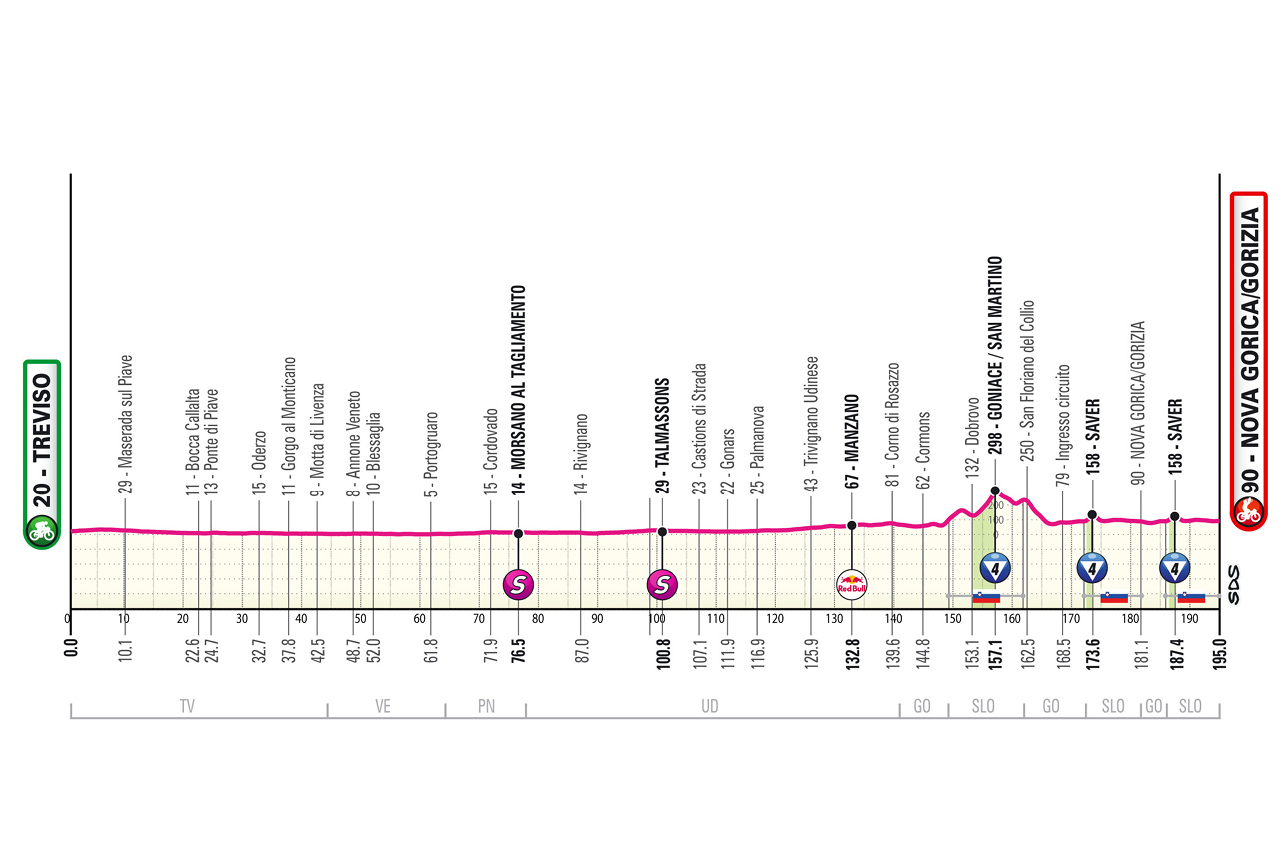
profile
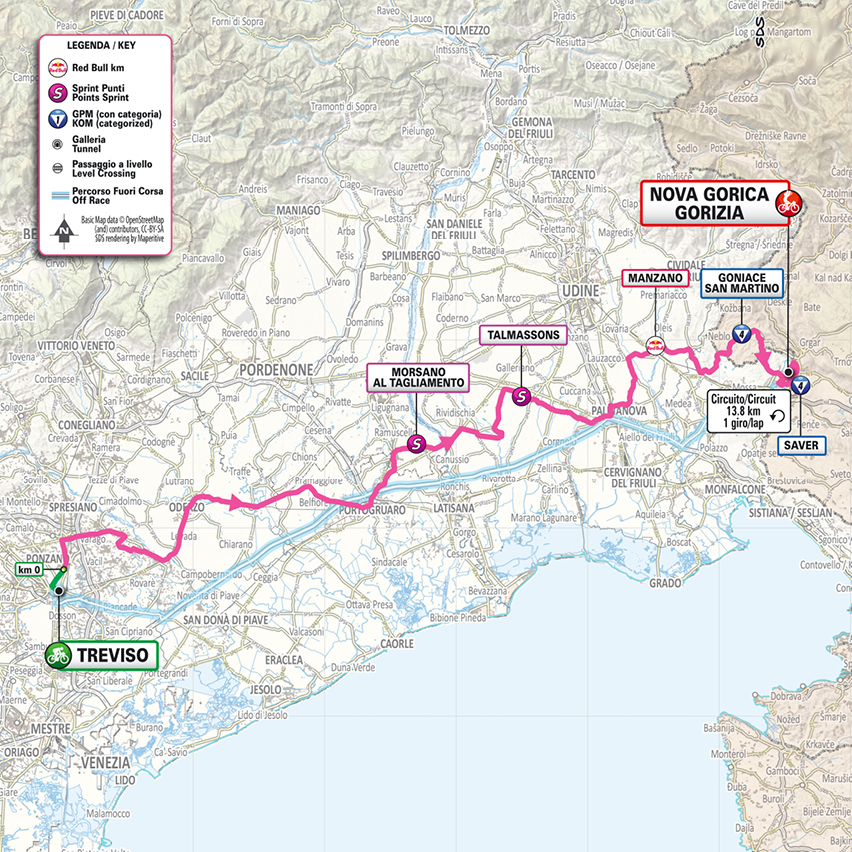
map
technical info
A flat stage with a few uphill kicks toward the end. The route crosses the Veneto lowlands, then enters Friuli after Cordovado and the Tagliamento River. Around km 140, the race enters Slovenia for the first time, tackling short climbs in the Collio (Brda) region before reaching Gorizia and beginning the final 14 km circuit. After the first passage of the finish line in Nova Gorica (Slovenia), riders complete one full lap. Roads are mostly straight with varying widths and usual traffic features in towns.
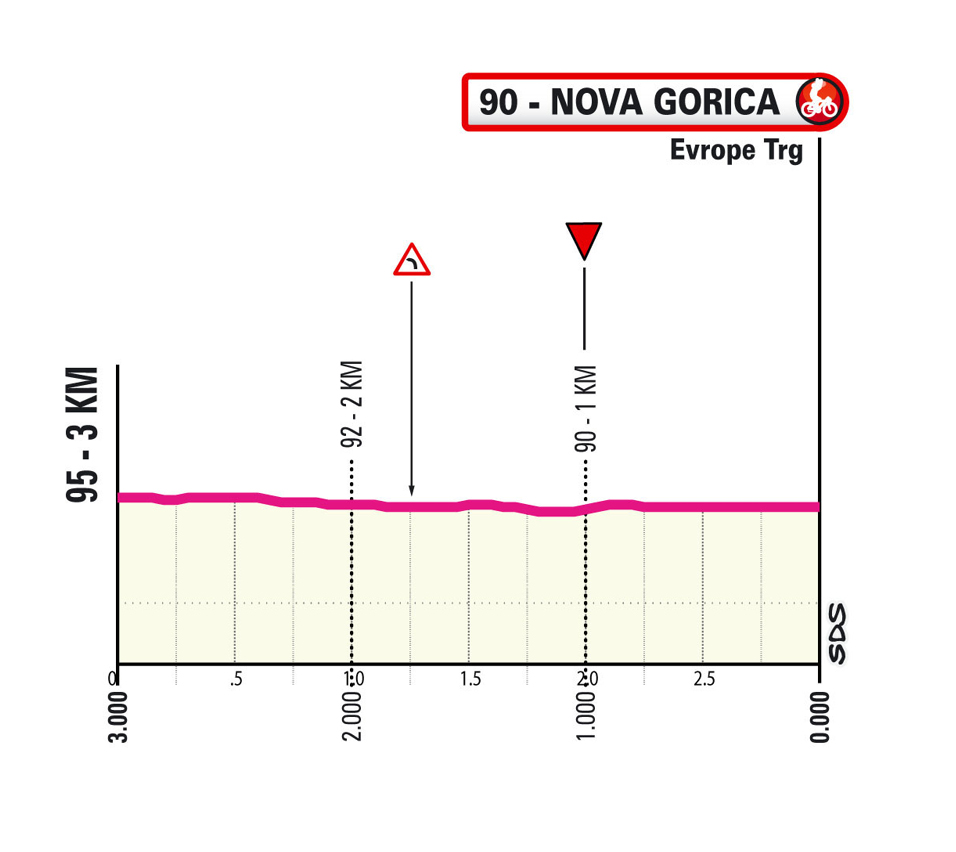
Final kilometres
After the short Saver climb, the final kilometres are flat, marked by many curves and roundabouts. The final straight is 900 m on 8-metre-wide asphalt.
start / finish

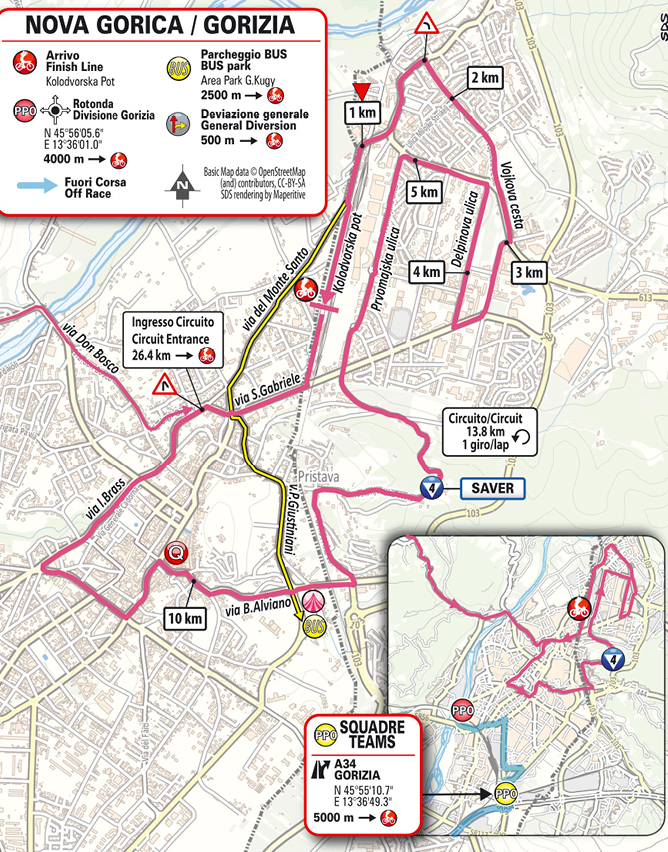
final kilometres
itinerary timetable

tourist info
Host city:
Treviso
Overview
Treviso is the historical capital of the Marca Trevigiana. Lying at the confluence of the Sile and Botteniga rivers, it is referred to as a “waterworld city”. Its many springs create a dense network of streams and canals that run across and around the city. The old town centre, located along the right bank of the Sile, dates from the Roman age. Piazza dei Signori is its beating heart. Treviso has a rectangular layout, with a maze of narrow alleys, lined with richly adorned houses, with porticoes and barbicans.
After surviving the Hun invasion, Treviso became a major commercial pole in the Roman age. It was later ravaged by the Hungarians, but eventually, it began thriving again. It was ruled by the Counts of Gorizia, by the Scaligers and by Venice, by Leopold of Austria, by the Da Carrara and the Visconti families, and once again by Venice. The city walls and gates provide evidence of the strong bond with the latter.
Later on, between the 18th and the 19th centuries, Treviso fell under the rule of Austria, the Kingdom of Italy, and Venice.
Treviso was bombed during both World Wars, and especially on 7 April 1944. On this fateful day, 159 Allied bombers destroyed 80% of the town’s buildings, taking a toll of at least 1,600 civilian casualties.
Treviso is a blend of history and grandeur, customs and passion, a city worth visiting for its stunning frescoed buildings, for its wealth of artistic heritage – on display at the civic museums – as well as for its popular restaurants, where traditional dishes are ubiquitous, along with Prosecco and the iconic bite-sized ‘cicchetti’.

Food
Local cuisine follow the excellent culinary tradition of Venice.
Below is a list of typical dishes, which combine the lovely flavours of seafood and land food.
Sopa coada is a hearty squab and bread soup, traditionally made from layers of bread, topped with grated cheese and boned wine-braised squab, which are then soaked in stock and baked for a few hours.
Pasta e fasioi is a staple of local cuisine. It is served as a thick soup made with creamed borlotti or Lamon beans, and ditalini pasta. Sometimes, a light mirepoix, or pork rind or cheek lard are used for added flavour. Traditionally, it is served on a layer of raw radicchio tardivo, and sprinkled with pepper.
Risotto with ‘rosoline’ is made with tender poppy leaves which are picked in the springtime, before the flowers bloom. The leaves are quickly blanched, and then eaten as a side dish, along with other leafy green vegetables, or used to make tasty risotto.
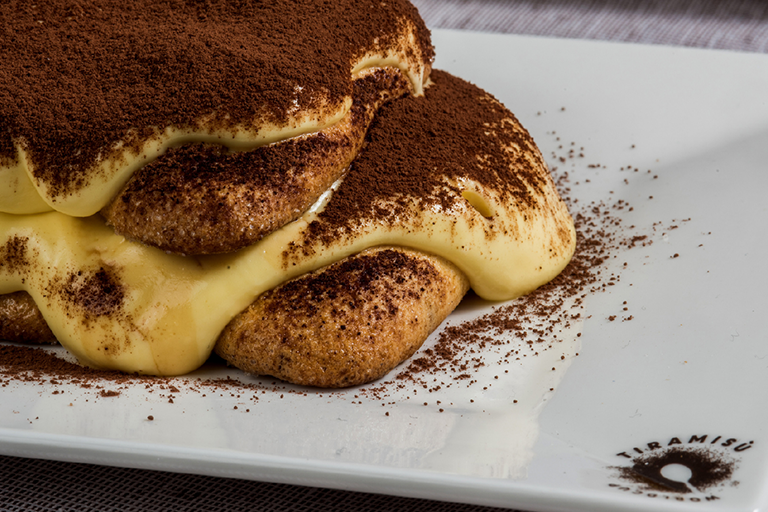
The most highly regarded typical products include tiramisù, radicchio and Prosecco, along with Casatella Trevigiana DOP (cheese) and asparagus.
Tiramisù is a layered dessert made from sponge fingers soaked in coffee, and a custard-like cream made with eggs, sugar and mascarpone cheese. The first known recipe, invented at Le Beccherie restaurant, dates back to 1962. The name of this dessert comes from the local vernacular expression “tirame su”, a reference to the uplifting effects of its ingredients.
The iconic ‘red’ radicchio first appeared in the 15th century. The winter varieties are grown by ‘forcing’ them after harvesting: left in the dark under tarps, the heads become crispier and tastier.
Casatella Trevigiana Dop is a fresh cheese that was traditionally made in farmers’ houses using the milk left over from direct human consumption. This cheese is soft and creamy, with a delicate scent of fresh milk and a sweet, slightly acidic taste.
Asparagus has been grown in the region since the Roman age. The stalks are ivory white, with hints of pink, and are used in flavourful traditional recipes such as risotto, or cooked ‘au gratin’, with morlacco cheese.

Beverage
Prosecco is the signature produce of the Alta Marca Trevigiana, and especially of the hills around Valdobbiadene. Here, halfway between the Dolomites and the Adriatic Sea, in a mild microclimate and on favourable soil, the finest Glera grapes are made into a balanced, characterful wine. Prosecco is an excellent pre-dinner sparkling drink. Covering a wide sweetness scale, from ‘brut’ to ‘dry’, it caters to a variety of different tastes.
Points of Interest
Treviso, the historical capital of the “Marca Gioiosa et Amorosa”, is known for the friendliness and the strong sense of belonging of its inhabitants. The town is a treasure chest of historical splendour, which includes the 16th century walls, the finely frescoed buildings, the iconic Fontana delle Tette (depicting a topless woman) and the traditional eateries.
Piazza dei Signori is one of the most popular landmarks, and the main hangout for the locals. It is the most exclusive part of the city, lined by historical public buildings such as the Palazzo del Podestà (including the civic tower) and Palazzo dei Trecento. The beautiful Loggia dei Cavalieri, nearby, has a finely decorated ceiling.
Departing from the central square, Via Calmaggiore, Via Palestro and the other main roads of the city are crowded with beautiful buildings, shops and traditional cafés and diners. If you’re in town, stop by one of the many typical eateries, and treat your taste buds to the specialties of local cuisine, paired with a glass of fine Prosecco. And at the end of the meal, taste the world’s best and most popular dessert, tiramisu – a favourite for date nights.
The Canale dei Buranelli is one of the most iconic landmarks, a perfect photo-op location and an oasis of peace, with beautiful arcades and bridges, clear waterways and a rich wildlife (mallards, moorhens, ducks and coots). The canal draws its name from a nearby palace that was the property of a merchant family from the island of Burano.
Wandering the streets of the town centre, you can admire the stunning, majestic architectures, and the finely frescoed buildings (13th-15th century) that have earned Treviso the name “Urbs picta”, which translates as “the painted town”.
Treviso is the home of one of the major museum hubs on a national level, which is headquartered in the Santa Caterina complex. Here, you can admire the beautiful “Storie di Sant’Orsola”, a cycle of frescoes by Tomaso da Modena describing the fashion at that time (one of the first ever). The Museo Bailo, located in the Borgo Cavour district, is the world’s largest collection of artworks by the local artist Arturo Martini, and by Italy’s leading impressionist painter, Gino Rossi.
Recently reopened, renovated and made digital, the “Collezione Salce” national museum, in Santa Margherita, is the world’s second largest collection of advertising posters after the one in Paris.
Treviso is home to one of the most beautiful theatres in northern Italy, named after the popular tenor “Mario Del Monaco”. The theatre has hosted performances by the greatest opera singers worldwide, and is currently a leading venue for world-class events, festivals and concert seasons.
Taking a gentle walk along the tree-lined avenues, you may admire the ancient city walls, built in the Roman age and later reinforced under the Republic of Venice. The imposing gates are still some of the most iconic landmarks of the city, such as Porta San Tomaso, built in 1518. The winged lion carved on the pediment testifies to the bond to Venice. The Sile flows nearby, making the place the perfect destination for easy jogs and bike rides.
Treviso is an excellent bike-friendly city, with a long pedestrian-cycle route – the “Rastera” – that runs along the Sile, through the nature, all the way to the sea, and bike hire points to enjoy the ride carefree.


Nova Gorica/Gorizia
Overview
Nova Gorica, located on the border between Italy and Slovenia, is a city that blends diverse cultures. Founded after World War II, it has become an important commercial and cultural center. Nova Gorica is famous for its casino and its close connection with the Italian city of Gorizia. It is also a key departure point for exploring the Collio wine region and the surrounding nature, which offers excellent opportunities for hiking and outdoor activities.

Gastronomy
The cuisine of Nova Gorica, along with the culinary traditions of the scenic Vipava Valley and the picturesque Brda region, is a perfect fusion of tradition and authenticity. Characterized by simple yet flavorful dishes made with fresh local ingredients, this gastronomy reflects Slovenian, Italian, and Austro-Hungarian influences, creating a harmonious blend of flavors that tell the story of the region.
Among the most representative dishes are gnocchi di Gorizia, soft and delicate, often served with rich, flavorful sauces, and jota, a traditional hearty soup made with sauerkraut or turnip, potatoes, beans, and pork, perfect for the colder months. Another standout specialty is pršut, an air-dried ham cured using artisanal methods, with an intense yet slightly sweet flavor, often paired with local wines and artisanal salami made from high-quality meats and seasoned with local spices.
A dish that truly embodies the simplicity and richness of the region’s cuisine is polenta bianca con toč, a rustic sauce made with peas and salami, delivering an authentic and comforting taste. Also essential in local dining are frtalje, omelets enriched with wild herbs hand-picked from the fields and forests, showcasing the rural traditions of the region. The area’s deep connection with the land is also evident in the wide variety of seasonal fruits, such as cherries, figs, and peaches, which enhance desserts and are often enjoyed fresh to highlight their natural sweetness.
One of the region’s prized products is the extra virgin olive oil from Brda, known for its fruity yet slightly spicy taste, a hallmark of superior quality that enhances dishes from salads to meats and seafood.
Completing this rich gastronomic landscape is the renowned winemaking tradition of the Vipava Valley and Brda, where both white and red wines of exceptional quality are produced. Indigenous grape varieties such as Zelen and Pinela, known for their freshness and floral notes, as well as structured reds like Merlot and Rebula, perfectly complement local dishes, turning every meal into an unforgettable experience.


Wine and beverages
Rebula (also known as Ribolla Gialla) is the queen of the region’s native white grape varieties, appreciated for its freshness, lively acidity, and pronounced minerality, making it a versatile wine with excellent aging potential. Alongside Rebula, the vineyards of Brda and the Vipava Valley produce high-quality international varieties such as Sauvignon Vert, Sauvignon Blanc, and Chardonnay, which develop unique aromas and flavors due to the region’s special microclimate.
Red wines, including Merlot and Cabernet Sauvignon, stand out for their structure, complexity, and aging potential, offering labels that compete with top international productions.
Beyond winemaking, the art of distillation is deeply rooted in Brda, where high-quality grappa and traditional liqueurs infused with aromatic herbs and local fruits encapsulate the authentic flavors of the land.
Among Slovenia’s wine regions, the Vipava Valley is particularly noteworthy for preserving 36 ancient indigenous grape varieties, some of which are rare and highly valued. Notable among them are Zelèn, an aromatic white wine with herbal and citrus notes; Pinela, offering a fresh, slightly fruity profile; and Pikolit, a rare grape often used in the production of sweet and dessert wines.
In recent years, Nova Gorica and Ajdovščina have also emerged as centers for craft beer production, with microbreweries specializing in unfiltered and unpasteurized beers that highlight natural ingredients and innovative brewing techniques. These beers rank among Slovenia’s finest craft products and attract a growing number of enthusiasts.
The region is also known for its high-quality seasonal fruit, particularly peaches, apricots, and cherries, which thrive in the mild climate and mineral-rich soil. These fruits not only enhance local cuisine but also serve as the base for excellent natural juices, free of additives and appreciated for their pure, authentic taste.
Points of interest
Situated along the Italian-Slovenian border, Nova Gorica is a dynamic city and an ideal departure point for exploring the region’s cultural and natural heritage. Some of its main attractions include the Monastery of Kostanjevica, which houses the tomb of the last French king, Charles X; the Solkan Bridge, renowned for having the world’s largest stone arch; and Mount Sabotin, a former battlefield now transformed into a Peace Park, where visitors can explore World War I trenches and enjoy breathtaking views over the Soča Valley.
The surrounding area, including the Vipava Valley, Brda (Collio), and the Karst Plateau, is famous for its extraordinary natural beauty, historical significance, and gastronomic excellence. The Vipava Valley, often described as a “Paradise on Earth,” is a dream destination for those seeking stunning landscapes and authentic traditions, while Brda (Collio), with its vineyards and orchards, offers a romantic setting and top-tier enology. Festivals and events dedicated to wine and local products, such as the Wine Train and winery tastings, provide unique opportunities to immerse oneself in the region’s traditions.
For adventure and sports enthusiasts, Nova Gorica and its surroundings offer a wealth of outdoor activities. The area is ideal for cycling, paragliding, trekking, and climbing, with diverse trails winding through valleys, hills, and rivers. The Path of Peace, a historical route that traverses sites linked to World War I, and the Alpe Adria Trail, which connects Austria to the Adriatic, allow visitors to discover medieval villages, castles, and breathtaking scenery while being fully immersed in nature.
The region’s cultural heritage is equally captivating, with castles, villas, and historic towns that reflect its aristocratic past. Notable destinations include Dobrovo Castle, home to a museum and historic winery, and Vila Vipolže, Slovenia’s most beautiful Renaissance villa, now a cultural center and exclusive event venue. The village of Vipavski Križ, with its ancient walls and cobbled streets, is one of Slovenia’s most picturesque towns, offering a journey back in time through its history and traditions.
Nova Gorica is also a symbol of cross-border cooperation, exemplified by Piazza Transalpina / Trg Evrope, a square split between Slovenia and Italy that represents the meeting of two cultures and European unity. From here, visitors can easily reach the Solkan Bridge, an engineering marvel with the world’s largest stone arch, offering spectacular views of the turquoise waters of the Soča River.
For those eager to explore the surrounding hills, Sveta Gora (Holy Mountain) is a significant pilgrimage site, where the basilica offers not only spiritual enrichment but also an incredible panoramic view over the Alps, the Soča Valley, and the Adriatic Sea. Another must-visit location is the Gonjače Viewing Tower, a 23-meter-high structure with 144 steps, providing a stunning 360-degree view over the rolling hills of the Slovenian Collio.