






profile
map
technical info
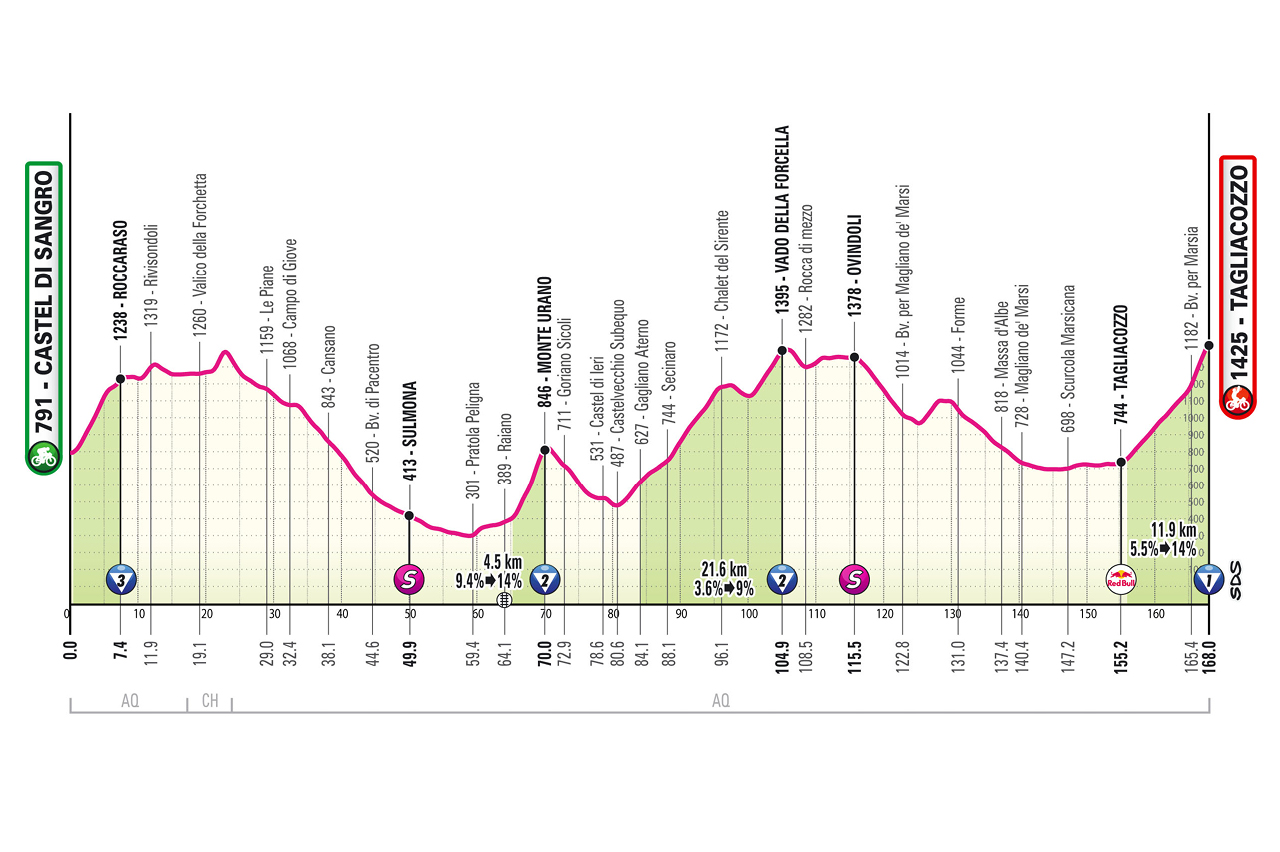
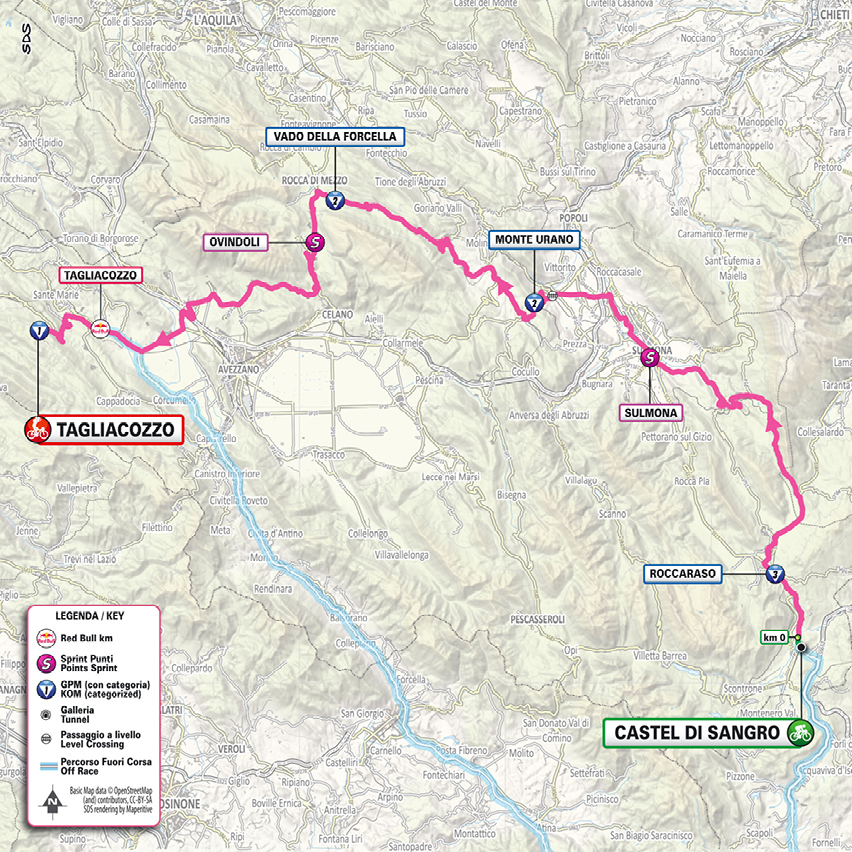
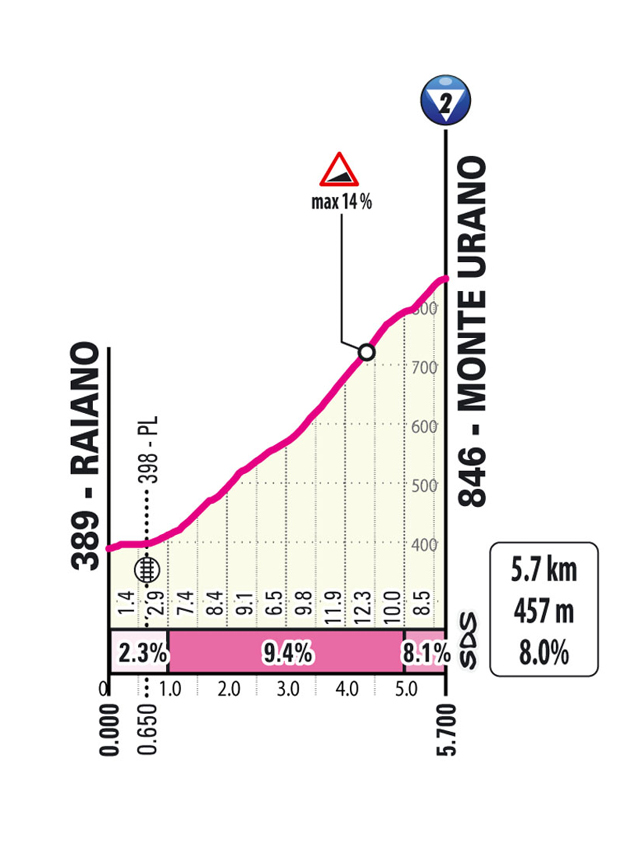
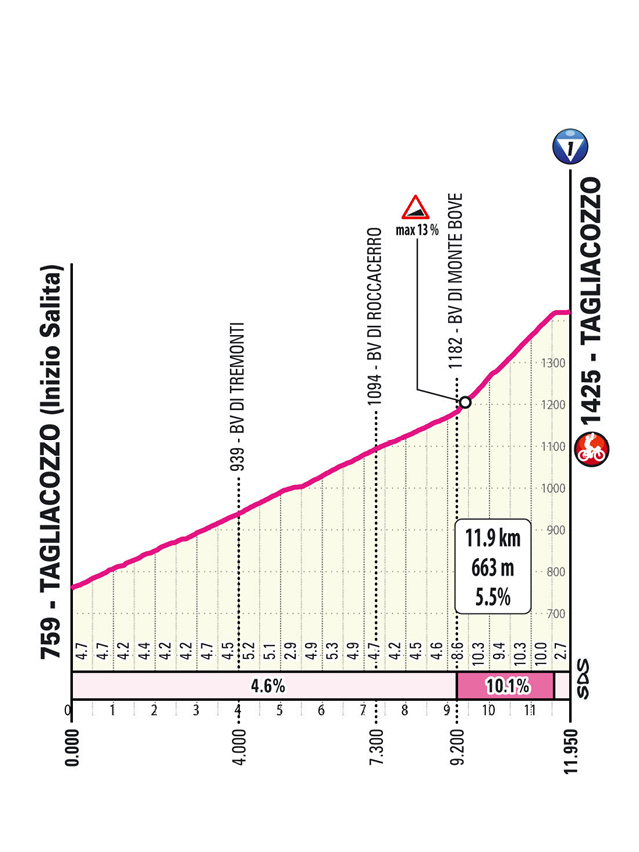
A tough Apennine stage with alternating long and short climbs and descents. Monte Urano is especially difficult: short but with ramps up to 14%. Mountain roads with varied gradients and terrain. The finale passes through the main town of Tagliacozzo before heading along the old SS5 route toward Marsia, where the stage ends.
Final kilometres
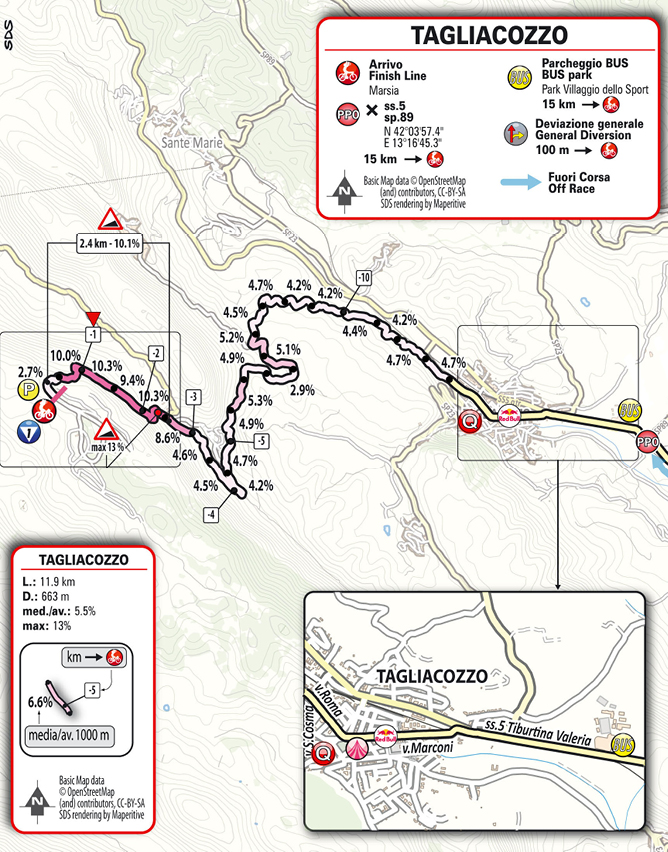
The final 3 km are entirely uphill with gradients reaching double digits (max 13%). The run-in features curves and wide switchbacks leading to a 200 m finishing straight on 6-metre-wide cobblestones.
start / finish

climb detail
final kilometres

itinerary timetable

tourist info
Host city:
Castel di Sangro
Overview
Castel di Sangro, called Aufidena by the Samnites, is the little town stretches down the hill slope as far as the confluence of the river Sangro with the Zittola where the bridge and ancient tavern mark the junction of the “tratturi” (sheep tracks) Celano- Foggia (Puglia) and Pescasseroli – Calenda (Puglia). The fortunate location of the trade and communications crossroad for the entire Abruzzo Region, fostered the growth of the town and underscored its role as “gateway to Abruzzo”. A flourishing sheep-rearing economy, furthered growth throughout the upper Sangro territory, brought advance of a wealthy shepherd class and the fortune of several confraternities, including the Santissimo Sacramento brotherhood who achieved sufficient social and artistic works, including rebuilding of the Assunta Collegiate (Convento dell’Assunta). The most interesting monument would have to be to the basilica of Santa Maria Assunta, put on the top of the mountain, is visible from all over the city. The basilica was rebuilt between 1695 and 1725, over the remain old church to a design by Francesco Ferradini of Como. Interesting some fews now remains of the ancient castle, documented at the end of the 9th cent. And indicated as a fortified location in the mid 12th, except for a few fragments and the lower part of a watchtower. Part of historical Aufidenate museum, set up at the end of the 1800 and closed due to wartime events, has now been opened in the renovated cloisters of the 16th cent Maddalena Convent. Castel di Sangro was the birthplace of famous Italian painter Teofilo Patini. In the center of the city is Piazza Plebiscito, an important place in the history of the unity of Italy. On 21 October 1860 the ambassadors gave the king Vittorio Emanuele II the positive results of the plebiscites for the annexation of the other southern provinces to the Kingdom of Italy.
Castel di Sangro is a center of great summer and winter tourist activities.
Known for the wealth of its sports facilities, the city hosts sporting events for amateurs and professionals. The city has numerous sports and accommodation facilities, suitable for practicing the major sports: football, basketball, tennis (the city is the Fit center – federal tennis center), sport fishing, water sports, swimming, cycling, motocross etc. A cycle path of about 10 km runs through the whole city and connects every part of it, the commercial and residential ones.
Outside the city, the Alto Sangro tourist area offers ski slopes and services of all kinds to winter tourism and to summer tourism the opportunity to visit mountain places of great excellence. The great out-of-town attraction of Castel di Sangro is the Abruzzo trans-Siberian, a fascinating experience, panoramic and at low speed, aboard a vintage train with restored carriages dating back to the early twentieth century. The historic train on the Sulmona-Isernia railway is a real museum in movement inside and outside the window, a showcase of a still authentic territory between Abruzzo and Molise and crosses two national parks and a nature reserve: the Majella National Park, the National Park


Gastronomy
Among the typical dishes to try: Cazzarielli and faciuli (fresh pasta and beans), pasta con gli orapi (fresh pasta with wild spinach) , pecora al cotturo (sheep wet)
The Pigna cake is a golden-brown donut, made from a long leavening process, softened by lard and flavored with aniseed. Other sweet is fafette, made from cooked wine must, also known in the Abruzzo tradition as mostaccioli. A local beer is also produced in Castel di Sangro, it’s called “Eva” from the Abruzzese Brewery.
Tagliacozzo
Overview
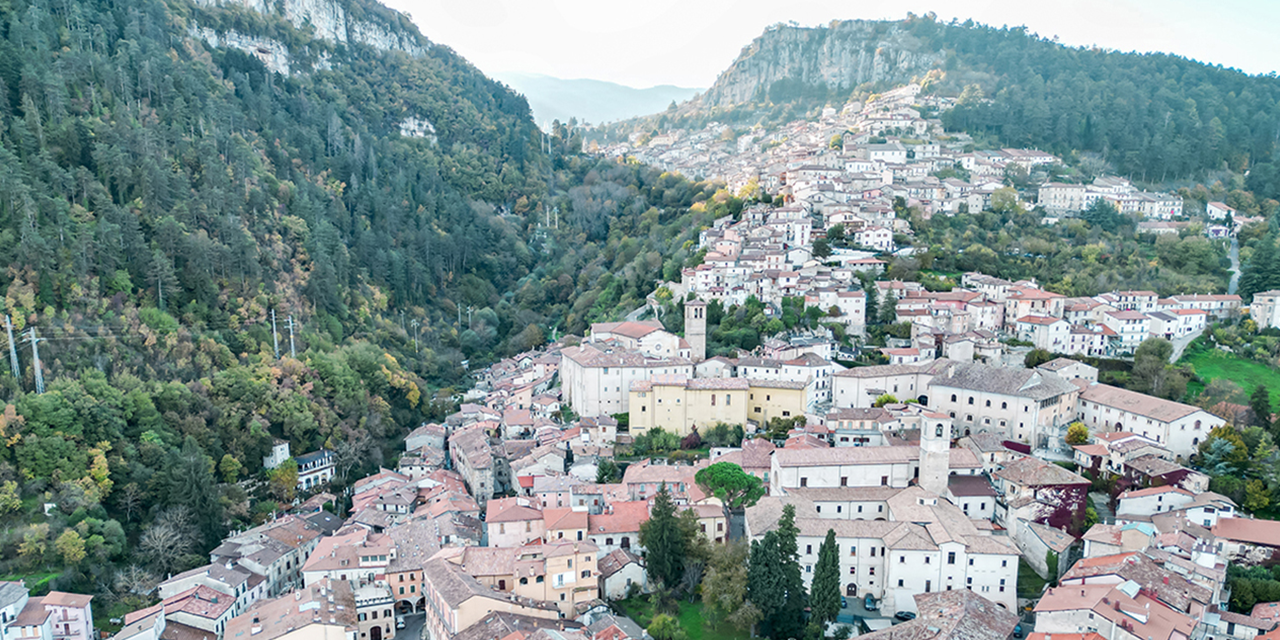
Tagliacozzo, located in the heart of the Abruzzo region and mentioned by Dante in Canto XXVIII of the Inferno, is famous for the 1268 battle that marked the end of Swabian rule. Founded between two rocks, it was a fiefdom of the Orsini and Colonna families. Since the late 19th century, it has been a well-known tourist destination, hosting cultural events such as the Mid-Summer International Festival and Carnival. Among its main yearly events are Holy Week, the Romantic Night, Dante Street, Birrart, and “Cellars in the Rock.”

Gastronomy
Tagliacozzo has been influenced over the centuries by Roman and Neapolitan culinary traditions. From the classic timballo di pasta, richly seasoned, to mountain tradition soups such as gnocchetti with chickpeas and maltagliati with lentils, to pecora “ajjo cotturo” (slow-cooked sheep) and lamb roasts. The local cheese production is also excellent, with medium and long-aged cheeses, as well as cured meats, including fresh and aged sausages. Other typical local dishes include cornmeal pizza with “sfrizzojji” and pizza summa. A special mention goes to the Cloistered Nuns of the ancient Benedictine Monastery of Saints Cosma and Damiano, who prepare traditional sweets shaped like horses for boys and doves for girls during the “Blessing Festival.” They also produce jams and liqueurs. In Tagliacozzo, throughout the year, one can also enjoy traditional Christmas sweets made with walnuts and honey, filled waffles known as nevole, and, during major festivities, the so-called “zuppa inglese,” a layered dessert of sponge cake and custard creams.


Wine and beverages
Montepulciano d’Abruzzo is undoubtedly the symbolic red wine of the region. Made from the homonymous grape variety, it stands out for its deep ruby color, aromas of ripe red fruits and spices, along with a well-balanced tannic structure. It pairs perfectly with robust dishes from the Abruzzo tradition, such as arrosticini and local cured meats. Trebbiano d’Abruzzo, on the other hand, is a traditional white wine known for its freshness and simplicity. With a pale straw-yellow color, it offers scents of white-fleshed fruit and wildflowers, with a pleasantly balanced taste. It is often paired with light Mediterranean dishes, such as seafood salads and vegetable-based first courses.
Points of interest
The symbolic place of the City of Tagliacozzo, illuminated 100 days before the Giro d’Italia, is Piazza dell’Obelisco, a harmonious space enclosed by historic buildings, at the center of which stands the namesake fountain, celebrating its 200th anniversary in 2025. Among the most significant buildings are the 15th-century Palazzo del Governatorato, once owned by the Orsini family, the 16th-century Palazzo del Governatore dei Colonna, and the 17th-century Palazzo Fallace, featuring a splendid loggia. The square was originally surrounded by a perimeter portico, whose arches were closed in the 19th century to create artisan shops and commercial spaces. The Obelisk Fountain, built in 1825 in honor of Saint Anthony of Padua, is modeled after Roman Baroque fountains: above an irregular rock stands a stone obelisk, topped with a bronze cross. Before the fountain, at the center of the square stood a stone seat known locally as “pilozzo”, which served as a pillory where debtors were forced to sit with their trousers down as punishment.
The Church of San Francesco, legitimized on 20 November 1233, is one of the first sacred buildings dedicated to Saint Francis of Assisi, just seven years after his death in 1226. The architecture, in perfect Gothic lines, preserves some precious historical and artistic memories of the city. The Talia Theatre was built in the 17th century by a Duke of the Colonna family and is named after the Muse Thalia, the protector of theatrical arts, who, according to legend, also gave the city its name. It is said that she resided in the cave near the springs of the Imele River, hence Taliae Otium, meaning the retreat of Thalia.
Also noteworthy is the Palazzo Ducale Orsini Colonna, one of Italy’s most important architectural and historical monuments, whose origins date back to the 13th century and which was later expanded and enriched over the centuries. A few hundred meters from the historic center, following a shaded path accessible to all, which runs alongside the ancient mills and the course of the Imele River, one arrives at the base of the rocky cliff from which the river, praised in Virgil’s Aeneid, emerges from the depths of Mount Aurunzo.
A few kilometers from the town, along the ancient route of the Via Tiburtina Valeria, reaching the highest point of the consular road at 1200 meters on Mount Bove, we enter the Marsia mountain area (the arrival location of the 7th stage of the Giro d’Italia), named after the mythological satyr who dared to challenge the god Apollo in a musical competition with the flute. From here, the valleys and forests of the central Apennine chain (Simbruini Mountains) unfold, home to Europe’s largest beech forest. In summer, the clearings within the beech forest become the setting for major concerts, including performances by renowned musicians such as Nicola Piovani, Alessandro Quarta, and Giovanni Allevi.