



profile
map
technical info
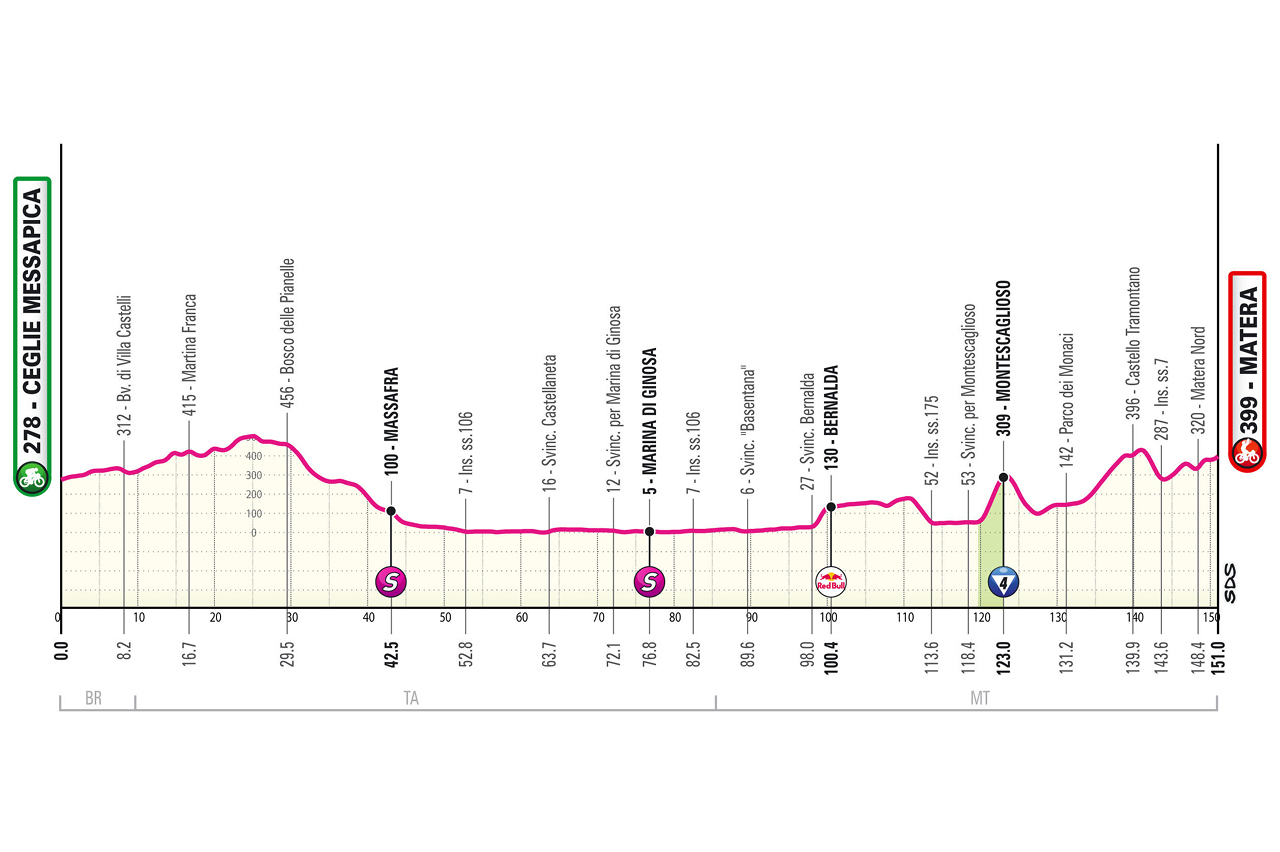
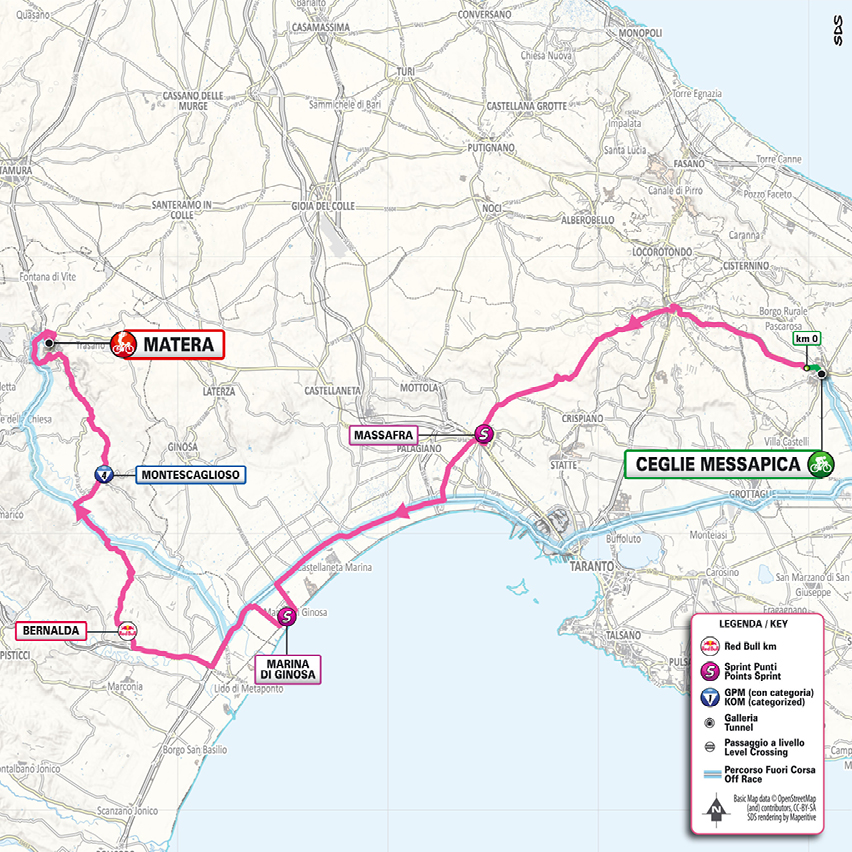
Largely flat stage until the final 35 km. The route begins on the Murge plateau, descends to Taranto, then follows the fast Metaponto coast road (SS106). The course leaves the SS106 toward the inland Bernalda climb, then continues on fairly wide roads toward Montescaglioso, a short, steep, and mostly straight ascent. A short descent and uphill false flat lead to the finish in Matera.
Final kilometres
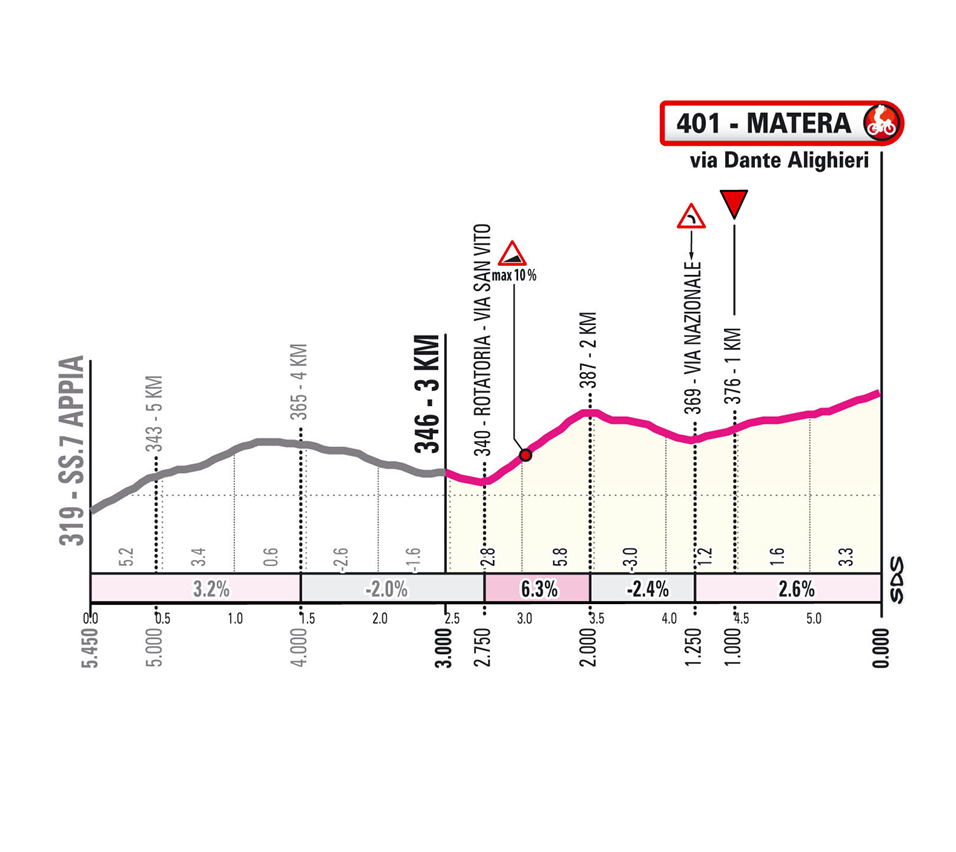
The final 3 km feature a 10% ramp leading into urban avenues, first downhill, then uphill to the finish. Around the flamme rouge, two left-hand curves (a tight one at 1,200 m) bring riders to a 300 m final straight, slightly uphill on 8-metre-wide asphalt.
start / finish
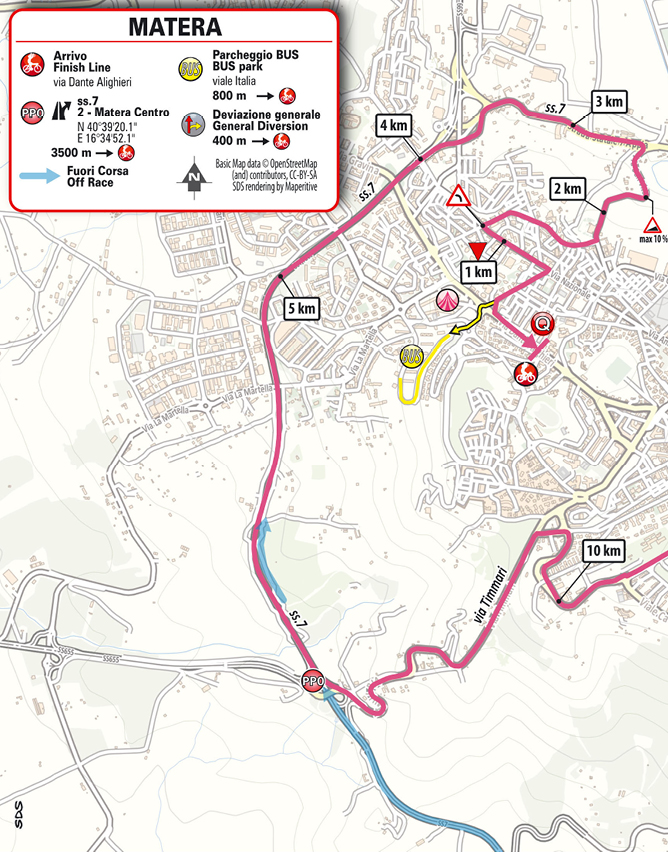
final kilometres
itinerary timetable

tourist info
Host city:
Ceglie Messapica
Overview
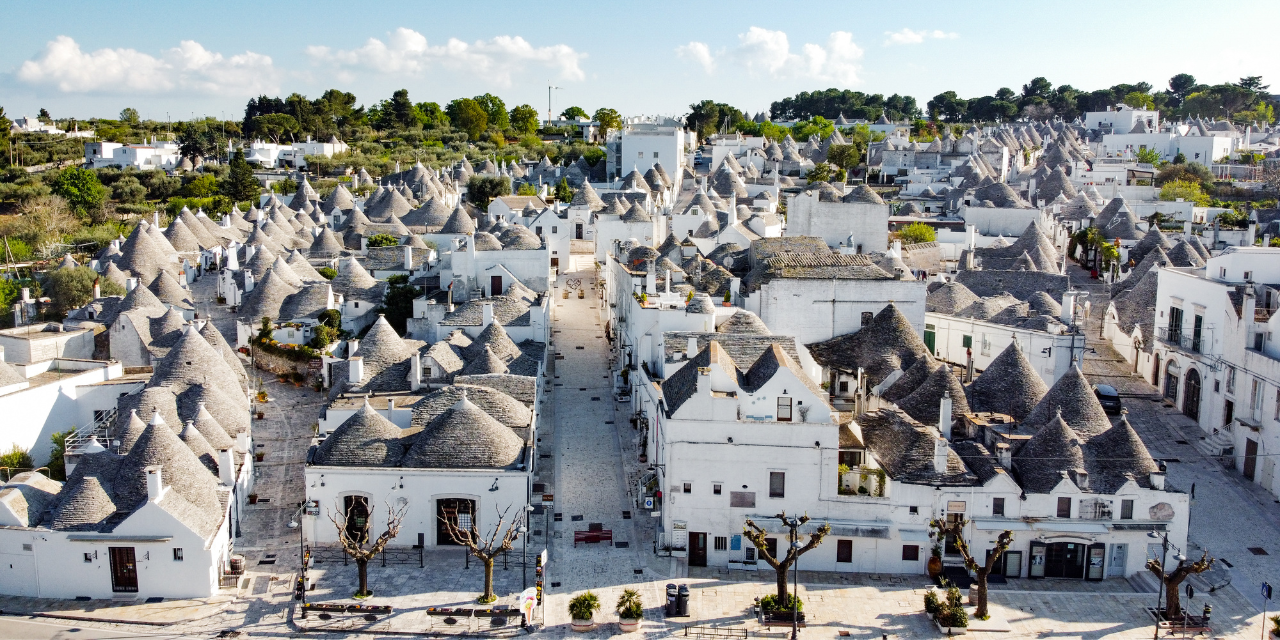
An ancient medieval village in the province of Brindisi, Puglia, Ceglie Messapica is famous for its extra virgin olive oil and culinary traditions. The historic centre, with its narrow alleys and stone houses, retains an authentic atmosphere. The Cathedral of Santa Maria Assunta, with its Romanesque façade, is one of the most important monuments. Ceglie Messapica is also renowned for its masserie, ancient farmhouses transformed into agritourisms.


Food
The cuisine of Ceglie Messapica features traditional dishes with strong ties to peasant and pastoral culture. Among its specialities is Sagna Penta, a lasagna traditionally prepared for Pentecost, made with a lean ragù of fried bread and lard. The Biscotto di Ceglie, or Biscquettələ, is a pastry made with almond dough and cherry or grape jam, flavoured with lemon and, in some variations, covered with a sugar or cocoa glaze. The Panino Cegliese is an explosion of flavours, combining tuna, mortadella, provolone, and capers. Grano Stumpato, a traditional Puglian dish, is made with pounded wheat seasoned with pecorino cheese, ricotta forte, or tomato sauce. A staple dish is Fave e cicoria, a simple yet flavourful meal of peeled dried fava beans and wild chicory, enhanced with extra virgin olive oil. Orecchiette and Strascinati are among the most iconic pasta shapes in Puglian cuisine. Frisella, a twice-baked bread, is often served with tomatoes and olive oil.
Among the main courses, Marretto, a roll of lamb offal, is a local delicacy. Bombette, small pork meat rolls stuffed and cooked over the grill, are another favourite. Lamb livers, known as gnumareddi, are also popular. The desserts include U Currucl (Scarcelle), an olive oil shortcrust pastry typical of Easter, and Dolci di pasta reale, also known as bride’s sweets, prepared for Christmas or Easter with almonds and sugar.


Wine and other drinks
The winemaking tradition of Ceglie Messapica and Puglia is distinguished by its native grape varieties, both white and red. Among the whites, Verdeca is widely cultivated in Puglia, while Bianco di Alessano, though of uncertain origin, is prevalent in the Valle d’Itria. Minutolo, an aromatic white wine, has a long history dating back to the 13th century, and Maresco is a lesser-known native grape found in the region’s old vineyards.
Among the reds, Susumaniello, typical of the Brindisi province, and Malvasia, which comes in white, sweet, and passito varieties, are noteworthy. Negroamaro, a hallmark of Salento, is known for its bold flavour, while Primitivo, produced in the Manduria area, is one of the most appreciated reds of the region. Ottavianello, also known as Ottaviano, is another local black grape variety, as is Notardomenico, typical of the Brindisi area.
Points of Interest
The Ducal Castle, dating back to the Norman era, stands out with its imposing Square Tower and the three circular towers added during the Swabian and Angevin periods. Today, it houses the Emilio Notte Art Gallery and the Pietro Gatti Library. Near the castle, visitors can find the city’s ancient medieval gates. The heart of local life is Piazza Plebiscito, dominated by the Clock Tower, built in 1890 in neoclassical style. This square is the town’s main gathering place and hosts cultural events during the summer.
Among the most significant churches is the Collegiate Church of Santa Maria Assunta, built in the 16th century on an ancient pagan acropolis and later expanded in the 18th century in Baroque style. The Church of San Rocco, erected in the 15th century on the city’s highest point, is dedicated to the saint believed to have protected Ceglie from epidemics. The Church of Sant’Anna, dating back to the 9th century and built on an ancient pagan temple, holds valuable works of art.
For breathtaking views, the Belvedere Monterrone offers a scenic lookout over the city, while the Urban Gardens preserve ancient terraces with vineyards. The Montevicoli Caves, discovered in 1962, are a fascinating example of karst formations, featuring stalactites and stalagmites.
Finally, Ceglie Messapica preserves important remnants of the Messapian civilisation, with traces of defensive walls, necropolises, and archaeological finds that narrate its ancient history.


Matera
Overview
Let yourself go, follow your instinct and wander around the stone labyrinths, where the incessant flow of time loses track of its trajectory. Capture the charm of a very ancient story and get closer to your deepest roots, starting from the heart of the Murgia plateau, from the tuff, consisting of tender and warm limestone, which is both mother and origin of Matera, the 2019 European Capital of Culture.
This soft rock has given birth to the Sassi, revealing both its cave districts: they are divided by a spectacular canyon, which is overlooked by the walls engraved in the guts of the earth of the Archaeological Park of the Rock Churches. A unique location nominated a UNESCO World Heritage Site for its historical, archaeological and landscape value. A unique magic that, over time, has achieved the fame of an extraordinary natural film set, where, especially at sunset, you will feel part of a nativity scene, full of meaning. Pure and authentic scenery with no signs of modernity, the Murgia Materana and the Sassi have seen traces of man since prehistoric times and bear witness to the history of humanity, having been continuously inhabited.
And it is precisely the timeless beauty of Matera’s unique townscape that made it a natural film setting, which has inspired many Italian and foreign film directors. Matera’s role in the filmmaking industry began with The Gospel according to St. Matthew (1964) by Pier Paolo Pasolini, who said that he had found in Matera those places and faces that went lost in Palestine. Other important film productions include: King David (1985) by Bruce Beresford, The Sun Also Shines at Night (1990) directed by Paolo and Vittorio Taviani, The Star Maker (1995) by Giuseppe Tornatore, The Passion (2002) by Mel Gibson, and the most recent Ben-Hur (2014) by Timur Dekmambetov, The Young Messiah (2016) by Cyrus Nowrasteh ) and James Bond 007 “No Time to Die” (2020) directed by Kary Fukunaga.


Food
Matera is the ideal location to taste the delicious regional cuisine and wines, bearing the DOP and IGP quality marks. Among the local specialities, there is Matera bread, with its fragrant flavour and characteristic shape that reminds of the Murgia landscapes. The bread is baked in wood-fired ovens and made using durum wheat and natural yeast. Cheeses are also exceptional, as they are produced using Podolica cattle, which can be easily spotted grazing freely in the pastures of the Murgia. Mouth-watering specialities include the ‘Fave e Cicorie’ recipe, a fava bean puree with chicory, and the ‘Crapiata’, which is the traditional mixed legume soup of Matera. ‘Matera DOC’ wines, both white and red, are also exceptional.

Points of interest
The Sassi of Matera are made up of two natural amphitheatres entirely carved out of the rock: the ‘Sasso Barisano’, to the north-west, which is largely formed by palaces and traditional houses, and the Sasso Caveoso, to the south, mostly made up of cave-houses. The ‘Civita’ district, which is the oldest inhabited group of buildings around the Cathedral, overlooks the lively panorama of the Sassi. As the day goes by, the colour and atmosphere of the town centre change significantly: during the day, the dazzle of the sun shines on the white limestone rock; at night, when the moonlight glows on the Sassi, you will experience the unique feeling of being in a huge nativity scene, with hundreds of small lights scattered all over.
The Parco della Murgia Materana, also known as the Historical Natural Park of the Rock Churches of Matera, boasts a natural and spiritual heritage of exceptional value, thanks to its over one hundred and fifty cave churches included in the UNESCO World Heritage List since 1993 Some of these places of worship date back to the Romanesque period and are richly decorated with frescoes and wonderful architectural elements such as apses, quatrefoils, capitals and arches, made even more beautiful by small domes.
Outside the city, in Pietrapenta, lies the Cripta del peccato originale (Crypt of the Original Sin), known as the “Sistine Chapel” of rock-hewn churches. The Crypt is decorated with mural paintings of the Benedictine-Beneventan style, dating back to the 8th-9th centuries AD. An extraordinary cycle of frescoes which depicts, among others, episodes of the Creation and the Original Sin.