The official route of the 110th Giro d’Italia was unveiled today at the Sala Sinopoli of the Auditorium Parco della Musica Ennio Morricone in Rome.
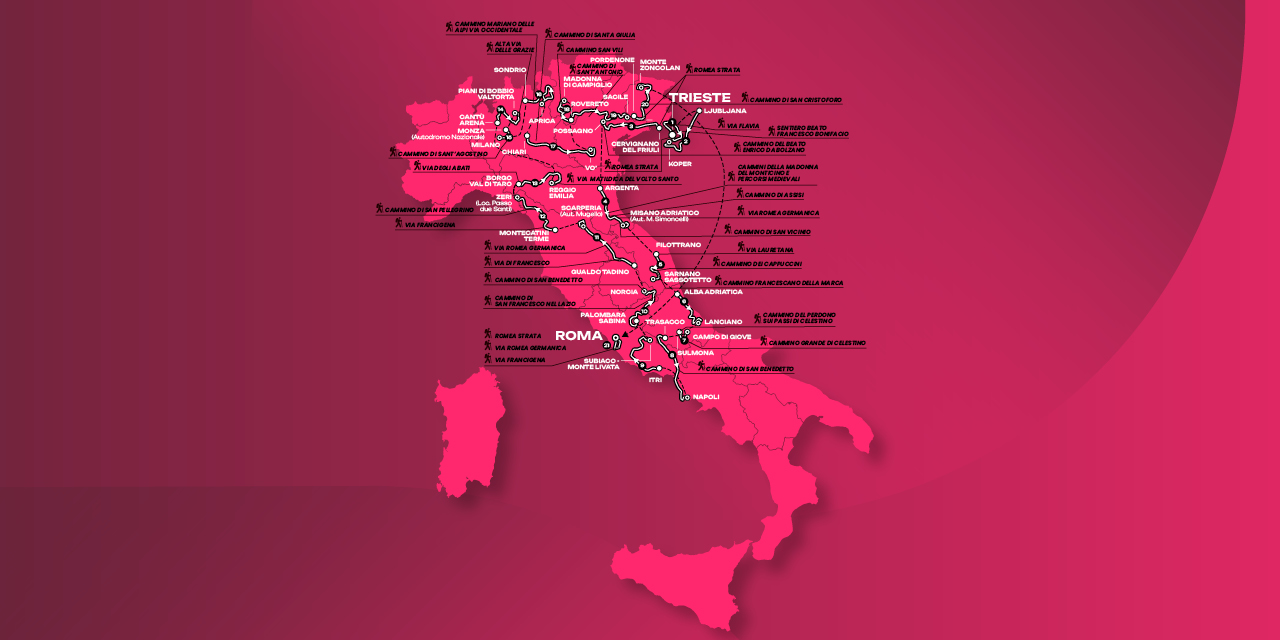
The race will get under way on Saturday, 8 May, in Trieste, while the Grand Finale will take place, as has become a recent tradition, in the Italian capital on Sunday, 30 May. The route promises to be particularly demanding, with an impressive 50,250 metres of elevation gain spread across the 3,418.9 kilometres of racing.
The presentation was hosted by Pierluigi Pardo and Cristina Fantoni, with Elena Cecchini, Giacomo Nizzolo and Moreno Moser providing insights into the technical aspects of the route. The event was attended by numerous representatives from the worlds of sport, entertainment, institutions and the Corsa Rosa‘s partner companies.
Welcoming the guests was Alessandro Onorato, Rome’s Councillor for Major Events, Sport, Tourism and Fashion. Also in attendance were senior executives from the RCS Group: Urbano Cairo, Chairman of RCS MediaGroup; Paolo Bellino, CEO of RCS Sports & Events; Luca Guercilena, Chief Operating Officer & Cycling Director of RCS Sports & Events; Matteo Mursia, Chief Revenue Officer of RCS Sports & Events; and Stefano Barigelli, Editor-in-Chief of La Gazzetta dello Sport.
Discover the route of the 2027 Giro d’Italia!
FIRST WEEK
The Giro d’Italia 2027 gets under way in Trieste, with the opening week offering a mix of opportunities for sprinters, undulating terrain and the first uphill challenges. The opening stage starts and finishes in the city of Trieste, crossing briefly into Slovenia and featuring three climbs in the final 40 kilometres. Stage 2, from Ljubljana to Koper, takes place entirely on Slovenian soil, while the following stage, from Cervignano to Possagno, brings the race back to Italy with a tricky 163 km route. The Corsa Rosa then heads into Emilia-Romagna for the Argenta–Misano Adriatico stage, where the Marco Simoncelli Circuit is likely to provide the setting for a battle between the sprinters. The first major test for GC contenders comes on Stage 5, from Filottrano, where the Giro d’Italia will pay tribute to Michele Scarponi on the tenth anniversary of his death, to Sarnano-Sassotetto. At just 139 kilometres but with 3,300 metres of elevation gain, the stage could already produce significant time gaps. The race then continues along the Adriatic coast with the Alba Adriatica–Lanciano stage, before tackling a 19.6 km uphill individual time trial from Sulmona to Campo di Giove. Over the weekend, the Corsa Rosa returns to Napoli for the sixth consecutive year, before heading back into the mountains on Sunday, 16 May, with the Itri–Subiaco-Monte Livata stage. This summit finish, already featured in last year’s Giro Next Gen, will bring nine demanding days of racing to a close.
SECOND WEEK
Following the first rest day, racing resumes in Lazio and heads towards the central Apennines. The 218 km Palombara Sabina–Norcia stage features 3,600 metres of elevation gain and a constantly undulating profile. The following day, the race’s longest stage takes the riders from Gualdo Tadino to Scarperia, finishing at the Mugello Circuit and offering another opportunity for the sprinters.
The race continues through Tuscany with an unprecedented uphill finish on the Montecatini Terme–Zeri stage, designated as this edition’s Tappa Bartali, where the Pink Caravan will tackle Passo dei Due Santi for the first time. Stage 13, from Borgo Val di Taro to Reggio Emilia, features a considerably easier profile, with 176 kilometres offering another chance for the fast men.
The second weekend promises to be particularly important for the general classification. Saturday’s 187 km stage from Cantù Arena to Piani di Bobbio/Valtorta features no fewer than 4,900 metres of elevation gain, with the Carovana Rosa tackling Ghisallo, Culmine di San Pietro, Miragolo San Salvatore and Alino, in that order. On Sunday, a 37.3 km individual time trial from Monza to Milano, starting inside the Autodromo Nazionale, will provide another crucial test.
THIRD WEEK
Following the second rest day, the Giro enters its decisive phase with the 192 km stage from Sondrio to Aprica, featuring 5,700 metres of elevation gain, making it one of the toughest days of the entire race. This will be a key stage for those targeting overall victory, with two ascents of the Mortirolo, designated as the Montagna Pantani, and the Gavia, the Cima Coppi. The following day offers another opportunity for the sprinters on the stage from Chiari to Vo’, before the race returns to the mountains with the Rovereto–Madonna di Campiglio stage, featuring the seventh uphill finish of this edition. Next comes the 199 km Rovereto–Sacile stage, with 3,000 metres of elevation gain, providing an ideal opportunity for attackers on the eve of the final summit finish.
Six years after Lorenzo Fortunato’s victory, the Giro d’Italia returns to Monte Zoncolan on the stage starting in Pordenone. The riders will tackle the legendary climb in the Carnic Alps from the Ovaro side, where Chris Froome triumphed in 2018.
The race will conclude with the now-traditional final parade through Rome, where, for the fifth consecutive year, the winner of the Corsa Rosa will lift the Trofeo Senza Fine into the sky above the Eternal City.
STATISTICS
- Friuli-Venezia Giulia hosts the Grande Partenza for the second time, following 1981, when Trieste staged a 6.6 km prologue starting and finishing in Piazza Unità d’Italia. Knut Knudsen took victory ahead of Francesco Moser and Gregor Braun.
- Trieste hosts a Giro stage start for the 19th time and a stage finish for the 23rd time.
- For the fourth time, a Giro stage will start in Slovenia, following Ljubljana–Tarvisio, Stage 16 in 1971, won by Dino Zandegù; Kranj–Lienz, Stage 13 in 1994, won by Michele Bartoli; and Bled–Gorizia, Stage 11 in 2001, won by Pablo Lastras.
- Napoli hosts its 48th Giro stage finish. In 2026, Davide Ballerini claimed his maiden Giro stage victory on the Paestum–Napoli stage. The city hosts a finish for the sixth consecutive year. The last time the Giro finished in Napoli for at least six consecutive years was between 1946 and 1955, a run of ten successive editions.
- In 2026, Milano became the first city to host 90 Giro stage finishes, with the total rising to 91 in 2027. The last two individual time trials finishing in Milano, in 2020 and 2021, were both won by Filippo Ganna.
- It has been 65 years since the first Giro stage finish in Aprica, in 1962, when Vittorio Adorni claimed his maiden Giro stage victory on the Moena–Aprica stage.
- The Gavia has been tackled ten times so far, first in 1960, when Imerio Massignan was first over the summit, and most recently in 2014, when Robinson Chalapud led over the top.
- The Mortirolo has featured 17 times to date. It was first climbed from Monno in 1990, with Leonardo Sierra first over the summit, and most recently in 2025, when Afonso Eulalio led the way.
- Monte Zoncolan hosts its eighth stage finish. Previous winners and the sides used for the final ascent were: 2003, Sutrio – Gilberto Simoni; 2007, Ovaro – Gilberto Simoni; 2010, Ovaro – Ivan Basso; 2011, Ovaro – Igor Antón; 2014, Ovaro – Michael Rogers; 2018, Ovaro – Chris Froome; 2021, Sutrio – Lorenzo Fortunato.
- Rome hosts its 52nd Giro stage finish. The Giro concludes in the capital for the ninth time in its history and, for the first time, does so for five consecutive years.
The Giro d’Italia and the spiritual trails
Starting this year, the Giro d’Italia aims to promote Italy’s major spiritual and pilgrimage routes, using maps, route plans, video content and destination promotion tools to tell their stories through the distinctive language and storytelling power of the Corsa Rosa. The project’s aim is to raise awareness of these itineraries and enhance their appeal, making them more accessible and strengthening their role as strategic assets for Italian tourism.
Among the most important pilgrimage routes crossed by the Giro d’Italia and Giro d’Italia Women are the Via Francigena, Via Romea Strata, Way of St Benedict and Way of St Francis.